


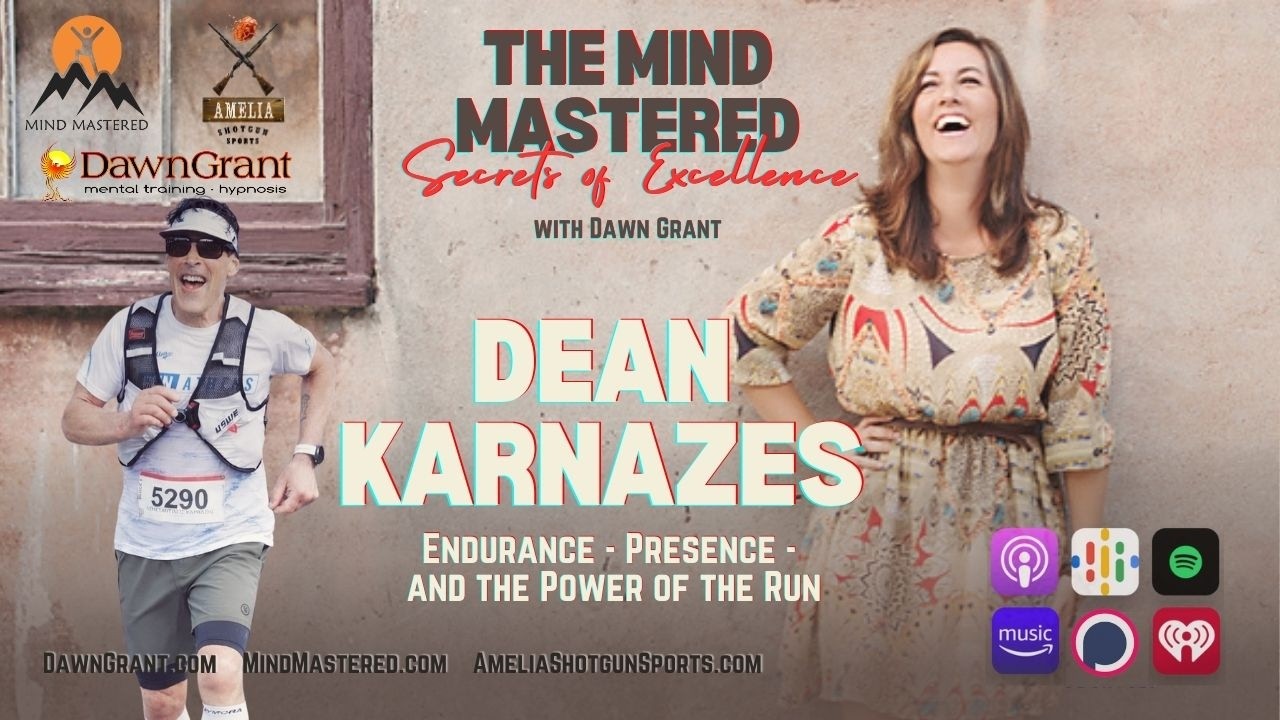
The Mind Mastered: Secrets of Excellence with Dawn Grant Podcast
Season 1 Episode 28
In this conversation, Dean Karnazes shares his journey as an ultramarathon runner, discussing the mental and physical challenges he has faced. He emphasizes the importance of being present in the moment, the therapeutic effects of running, and how he copes with pain and loss. The discussion also touches on the concept of the 'zone state' in running, mindfulness techniques, and the adaptability of the human body. Dean's insights provide a unique perspective on endurance, mental health, and personal growth through the lens of running.
Follow Dean on Social Media.
All contact information is provided in the podcast.
Visit https://dawngrant.com/pages/free to grab your exclusive free resources—hypnosis audios, mental training tools, and even a golf cart at her club!
Podcast Transcript:
Dawn Grant (00:00)
Alrighty folks, thank you for joining us. This is Dawn Grant, the Mind Master Secrets of Excellence. I ⁓ love all your feedback. Thank you for following and ⁓ I have really been enjoying getting to know people who are excelling in different areas of their lives. ⁓ know, most of you know I do work with athletes on the zone state, the mental game, and so I do enjoy talking to different kinds of athletes to pick their brain on.
Dean Karnazes (00:19)
That's.
Dawn Grant (00:28)
how they've been experiencing what could be the zone state, what gets them out of it, what challenges they face, and then overall, because we have the same brain in life that we have in sport, so what challenges people are overcoming and some of those secrets that we can share. So today I have
Dean Karnassus with me, and I'm super excited, because talk about some excellence. Dean has done some amazing
physical things more than I could ever imagine doing running 350 miles in 80 hours in 44 minutes without sleep. That is what I want to know about. And then a bunch of other really cool things related to running and ⁓ Dean, thank you for being here. Please give us some of your highlights. What are your, see trophies all around you there.
Dean Karnazes (01:07)
Okay.
Well,
I I've been running marathons and ultramarathons for about the past three decades. And I guess I'll digress and say an ultramarathon in Latin, ultra means beyond. So an ultramarathon is anything beyond a marathon and a marathon is a fixed distance of 26.2 miles. So an ultramarathon might be 30 miles, 50 miles, a hundred miles, 200 miles. Anything beyond a marathon is considered an ultramarathon.
And I've raced and competed in these types of races on all seven continents of earth twice, including doing things like running 50 marathons in all of the 50 United States in 50 consecutive days. So I've really pushed the limits of physical and mental endurance.
Dawn Grant (02:12)
Yes, my gosh. I cannot wait to get in your head.
Dean Karnazes (02:16)
Yeah.
Dawn Grant (02:18)
every continent twice and I thank you for defining ultra marathon because I know not everybody knows for sure what that is and if I haven't said it right, thank you for being here. ⁓ So I like to just start from the beginning because I like to try to understand the person and see what got them to where they are. So ⁓ at what age did you start running and why?
Dean Karnazes (02:46)
I have an interesting backstory in that my earliest childhood recollections are running home from kindergarten. So I remember... I actually was trying to get away from this imprisonment I saw at school. Unfortunately, I remember sitting in class and everyone telling me I should sit still and pay attention. So trying to be a good boy and sitting still and paying attention. And then when the bell rang...
Dawn Grant (02:54)
Were you being chased right?
Dean Karnazes (03:16)
I thought I'm free. And I remember running out of the classroom and, you know, this was in Los Angeles back in, I don't want to date myself, it was the sixties. So it was safer, was safer for a, you know, a five year old kid to run say a mile home from kindergarten back then. But I remember I just, how the air felt on my skin and you know, how this lake I used to run by in this park. And I remember all these things.
Dawn Grant (03:17)
Yes.
Ha!
Yeah.
Dean Karnazes (03:45)
from being a little boy. And then I ran competitively up until I was a freshman in high school and we won the championships. And at 14, I said, okay, that's as far as I'll ever take my running career. And I stopped running altogether. I thought, you I have better ways to spend my time than running. So fast forward to my 30th birthday.
So I somehow finished high school, I finished college, I went to graduate school, and then I went and got an MBA, and I had a very comfortable corporate job in San Francisco. And on the night of my 30th birthday, I was in a bar with my buddies doing what most people do on their 30th birthday. I was drinking. And at midnight, I told them, hey, I'm leaving. And they said, what do mean? It's midnight, let's get another round of tequila to celebrate. And I said,
Dawn Grant (04:19)
Okay.
Right
Dean Karnazes (04:36)
No, I'm gonna run 30 miles to celebrate my 30th birthday instead. And they looked at me and they said, but you're not a runner, you're drunk. And I said, I am, but I'm still gonna do it. And I literally walked out of the bar. I'll never forget, I didn't own running gear, but I had these comfortable like silk boxer shorts, these silk underwear, peeled off my pants and threw them down the alleyway. I just started stumbling, heading south into the night drunk.
Dawn Grant (04:40)
wow.
Yeah.
my.
Dean Karnazes (05:06)
knowing that town called Half Moon Bay was 30 miles away from San Francisco. And that night forever changed the course of my life.
Dawn Grant (05:14)
That is an unbelievable story. So I am curious, so if you rewind, you hadn't ran in what, 15, 20 years or something like that? And how far did you run, you know, up when you had stopped earlier in your life? Was it ever 30 miles?
Dean Karnazes (05:31)
No, mean, you know, cross country when I was in high school is about two and a half miles. So.
Dawn Grant (05:37)
What in the world?
That tequila did it.
Dean Karnazes (05:41)
tequila and you know, I was you know, I actually I was very dissatisfied with with life I am, you know, maybe 30 years too young to have a midlife crisis, but I think I had kind of a breakdown because I thought, you know, if I went and got a good education, I landed a good job and I had a fat paycheck and know, stock options and a company car and all those things, I'd be happy. And I was miserable. Like all these things didn't bring me to happiness and the fulfillment. I thought they would.
Dawn Grant (05:47)
Yeah.
Yeah.
Right.
Right.
Dean Karnazes (06:10)
And I
just wanted to do something primal, like something that made me feel alive again, and it manifested as a 30 mile run.
Dawn Grant (06:18)
very interesting and that whole midlife crisis thing, think just the feeling of not being fulfilled can happen at any time in our lives. In some way, you were kinda saying it was happening in kindergarten even. It didn't feel like you, it didn't feel like you were fitting into that situation. ⁓ In my opinion, that's a lot of what we call midlife crisis is just like.
Who am I and what am I doing and where am I at and where would I prefer to be and what would I prefer to be doing? And the challenge is figuring out who am I and what do I prefer to be doing? Because we are like on autopilot each day, right? And doing what we're supposed to do and like a little robot going through life.
Dean Karnazes (06:44)
Okay.
Yeah, I mean, unfortunately, I think a lot of people live their whole life that way. And I just I haven't I mean, I can never sit still when I'm always, you know, seeking new challenges and new adventures and, know, kind of living on semi nomadic life. But, yeah. ⁓
Dawn Grant (07:06)
I- yeah.
Yeah.
Yeah,
when it was probably 15 years ago or so, and that was the first time I'd been exposed to Ultramarathon because I dated a guy that did them regularly. And I just remember being so amazed because I think he had flown or whatever to it seems like it was maybe Colorado or something out there. And he was doing, you know, a bazillion miles. And I just remember thinking, he's not sleeping.
Like I would go about my day, like I breakfast and think, he's running right now. And then, know, like lunch or early afternoon picking up my kids from school or something, I'm like, he's still running, you know? And then it would be like dinner and I'd be like, my God, I remember going to movies and watching a whole movie and then thinking, my God, he's still running, you know? It's amazing to me, really. I think I could probably say of any sport.
Dean Karnazes (07:52)
Thanks
Thank
Okay.
Thanks.
Dawn Grant (08:17)
It's the one that amazes me the most. Of course, you know, there's mountain climbing and all that, but I don't know. Not sleeping and running that long. How do you explain that?
Dean Karnazes (08:18)
I'm.
Well, I mean, think it's, you know, running is very identifiable. You climbing Mount Everest or climbing the north face of K2 or whatever, it's intense, I'm sure, but it's not an everyday experience, right? We've kind of removed from that. But everyone has run a mile, right? It might have been, you know, you got in trouble when you're in school and the teacher said, go out and run around the track. And you know how much it sucked, right? How tough it was.
Dawn Grant (08:49)
Right.
Thanks.
Dean Karnazes (08:55)
And then you think, I could barely run around the track, how's someone out there running for 24 hours without stopping? And it's hard to your head around it because it's so familiar, running is such a familiar activity with any human being. So I think that's one reason that ultramarathon, ultrarunning is so fascinating to the general population because you just can't understand it. And when I first heard of someone running a hundred miles,
Dawn Grant (08:57)
Yeah.
All
Dean Karnazes (09:21)
I thought there was trickery involved. thought, okay, you know, they get in a car, there's a bike like hidden behind the bushes, you know, or they stop at hotel that night, you know, and they get up the next morning and carry on. But this guy said to me, no, nobody, the gun goes off and you start running and you you finish when you cross the finish line, if you cross the finish line, but it's one nonstop run.
Dawn Grant (09:25)
Alright.
Yeah, yeah, okay, so you're on Tequila, you run 30 miles. How long did that take you?
Dean Karnazes (09:53)
Well, I mean, I say I ran, but let's be honest, I was shuffling, was walking, I was stumbling. I mean, I was a mess. And I ran all night. I remember I saw the sun come up the next morning. So it took me the good part of nine hours to run 30 miles and I was destroyed. I mean, I was completely wrecked and I'd never felt so alive.
Dawn Grant (09:55)
You had c- Yeah. Yeah. Yeah. Yeah.
Wow.
Yeah.
Yeah.
Dean Karnazes (10:18)
I came to life that night. mean, was as though God spoke to me and said, here's your purpose. sure, it's not anything sophisticated. It's just running. It's a pretty simple act, but this is why you're here. I mean, this is what you're meant to be doing.
Dawn Grant (10:35)
Interesting. ⁓ once a year myself and so, and this is like same and different, but like my brain's related a little bit. ⁓ Once a year myself and several of my friends used to do this Amelia Island ⁓ nature walk thing. And we would walk from the south end of the island all the way to the north end. And it would take us about eight hours. And it was a very leisurely walk. There was no jogging or anything.
But I just remember feelings, and I haven't done it in a little while, but I remember feeling so amazing. And of course my legs were like rubber the next few days. But being outside and just I guess connected that whole time, it's so much different than let's say being outside for an hour. And you know, especially because we were walking and we were looking and we were experiencing and we were sometimes having deep.
meaningful conversations and other times totally quiet, know, and ⁓ so, you know, that period of time I can relate to, not the jogging part. Do you feel like that's a big part? Yeah.
Dean Karnazes (11:41)
Well, I mean, I do
the same sort of thing I do, you know, by myself, though, is the only difference. So I prefer to run alone in nature and I commune with nature. mean, I think that we came from nature and 99.9 % of
Dawn Grant (11:55)
Yeah.
Dean Karnazes (11:58)
people across the globe are completely removed from nature. I mean, we live in, you know, air conditioned houses, we get the air conditioned cars, we go to air conditioned offices. I can't live that life. I mean, I have to go out and be in nature just to find who I am, to find myself, to find peace. And I think it's a tragedy that so many people are, you have lost any sort of relationship with nature. And you saw it just in, you know, in your adventures you did with your friends. You know, imagine doing that by yourself where you're kind of forced.
not to talk with other people, not to interact with other people, but just to interact with the landscape and the environment.
Dawn Grant (12:34)
Sounds like a challenge that I'm wanting to take on like that sounds pretty amazing My brain always thinks of analogies and like it's relating and relate and you're now reminding me of the TV show alone Where they go and live by themselves, you know in the challenge one of the biggest challenges by day Whatever 50 60 90 is being by themselves for so long and all of their thoughts and again being really fascinated and
and into the mind, one of the things I've observed watching different episodes of that, and I imagine this happens to you when you're running, you'll have to let me know, but all of a sudden, a lot of childhood memories start popping up and things they have never thought of again in their lives, and I've come to really appreciate that, meaning we can get so caught up in our day-to-day lives.
Dean Karnazes (13:12)
Okay.
Dawn Grant (13:32)
and our to-do list and our, whether it's social media, the phone or TV or conversations
Dean Karnazes (13:39)
Okay. ⁓
Dawn Grant (13:39)
with others or drama or whatever it is, that how often do we really take a true break, like a true break, not I'm still looking at my phone or I'm still checking social media, like a true break where it's you in nature. ⁓
And I've just been really fascinated with how many things from their lives they start processing and thinking about, and
some sad and some happy and some that they probably would have buried forever if they didn't stop long enough to really work through them. And some people actually leave the show when that starts getting challenging, meaning those old thoughts start coming up and they don't want to deal with them. So is that something that happens when you're
Dean Karnazes (14:09)
Okay.
Dawn Grant (14:29)
Running long distance, do you have a lot of thoughts coming forward from earlier in life and such?
Dean Karnazes (14:36)
At a point I do, but I actually I try not to think at all When I do these sort of things I try to rejuvenate myself by being in the present So I try not to think about how much further I've got to go or even which route I'm gonna I'm gonna choose I try to be in the here and now the present moment of time and I try not to reflect on the past so I try and this is This takes discipline right to be in the here and now our minds are so active as you said I mean even now is we're
Dawn Grant (14:55)
Nice.
Dean Karnazes (15:06)
we're talking, you're probably thinking, what's the next question for Dean? You know, did I water my plants? You know, are we going to have for dinner? You know, did I feed the dog? But to quiet your mind and just be in the present moment of time, that to me is so cleansing that when I come back out of it and I started having those, you know, thoughts about the past, mean, let's face it, if you, you know, live in the past, you're going to live in sadness because being alive, you know,
Dawn Grant (15:11)
No!
Dean Karnazes (15:35)
being a human is suffering. So probably a lot of the thoughts of the past are gonna be hard thoughts. And if you live in the future, you're gonna have a lot of anxiety. If you're thinking about the future all the time, you're gonna be filled with anxiety. But to put those aside and just be in the present moment of time, you really feel alive. And honestly, even though by myself and I'm out in the wilderness alone, these are some of the purest moments I've ever had.
Dawn Grant (16:01)
Nice. Yeah, what you just touched on is what I teach athletes. It's to be present in moments. And it's really hard for a lot of athletes because, you know, whether it's golf or whatever, they do get caught up in thinking about the miss or what just happened. And so there these regrets of the past and then they can worry about their score, the future, or even get too amped up if it appears they're going to win. So there's all these games that the conscious mind will play.
related to future or past. And so, yeah, my training is all about bringing them to the present moment. And it is challenging and it is a discipline. And no wonder you've succeeded so much because you're mastering that concept. And ⁓ as you were talking, I was like, well, that makes sense. Compared to that TV show, The Lone, you have to be able to be physically doing well and at your peak state.
Dean Karnazes (16:35)
Okay.
Dawn Grant (17:00)
in order to continue and so
processing what you said, every thought has an effect on your body. So yeah, if you're starting to think of the past and my fifth birthday and nobody showed up for my party, that then has an effect on the body which can actually decrease your energy and ⁓ endurance and everything. ⁓ totally following what you're saying, you absolutely would have to be present. And really hard work.
Right? ⁓ It was probably 10 years ago now, but for a long time Buddhist monks didn't really get interviewed or get spoken to or asked questions about their meditation processes. And until about 10 years ago, it might even be longer than that now, but you know, they got put up to, connected to EKGs and such. And when they were asked, you know, when you're meditating eight hours a day, every day,
Dean Karnazes (17:35)
Okay.
Dawn Grant (17:58)
are you totally clearing your mind? And it
was surprising to actually hear them say, the mind isn't 100 % quiet. It's that thoughts will come in and they let them pass like clouds. They'll come in, but they don't get emotionally attached. They don't jump onto it and go, my gosh, yeah, that's horrible. yes, that would be great. They don't emotionally attach.
Dean Karnazes (18:03)
I'm.
.
Dawn Grant (18:25)
They just let them pass through like clouds and recognize them as just traveling through, right? Is that something you do?
Dean Karnazes (18:35)
Well, it's something that I've learned to do and I would say somewhat out of necessity because when I was 21, I had a ⁓ tragedy in my life. My younger sister was killed in a car accident on her 18th birthday. And we were really close. She was like my closest confidant, my best friend. And ⁓ when she died, ⁓ it completely unraveled me.
And I really never had the tools. I never worked with anyone. mean, this is, you know, several decades ago. And I just threw my own mental resilience in the pain and the misery that I suffered. learned to do just what you said, you know, to think of her. But, and it's, know, when something dramatic and traumatic happens and you witness it, you can't erase these,
these things from your mind. I mean, they stay with you. and if you think about these things, they're so painful and they cause so much anxiety that ⁓ I learned that when these things start to come, just to let them go, don't delve into the actual memories. Don't try to recreate the scene and if you could have done this, maybe this would have happened, this or that, just to have a, it's a cloud that passes by.
Dawn Grant (20:00)
Yes, yeah, sorry.
Dean Karnazes (20:02)
But I think to me it's
more reaction to pain. mean, once you suffer such acute pain like that, you learn this technique just out of survival. mean, you either, it either kills you or you learn how to adapt and survive.
Dawn Grant (20:15)
Exactly, exactly. I ⁓ know somebody whose mother passed away within days of giving birth to him. And then the sister took care of him until he was eight. And then she got in a car accident and had chronic brain damage and then died shortly after. And his father died at 11, when he was 11. And ⁓ I'm amazed at getting to know him and how ⁓
he can be present and peaceful in life, meaning out, and I look back and think it was exactly what you're saying. It's a survival mechanism to, because you can either get sucked into that and emotionally attach to those traumas and maybe drink yourself to death or do drugs and whatever to disconnect the mind, or you can learn to disconnect yourself from those thoughts, right, and let them pass.
Dean Karnazes (20:51)
up.
Dawn Grant (21:15)
People can do it with drugs or things to alter them or they can learn to do it naturally.
Dean Karnazes (21:25)
Yeah, but I also think there's a magic to running. mean, you know, there's been a lot of studies about
⁓ PTSD and running and other ⁓ like ⁓ they're using running as therapy. I don't know how it works. really I don't because I you know, maybe it's endocannabinoids but I can tell you that every time I leave the house with a thousand problems on my shoulders, I come home and when I walk back through the door, somehow the weight has been lifted. I don't know what it is.
It just shifts your paradigm in such a way, maybe it's your mood, I don't know, maybe it's biochemical, but running has saved my life, and I really mean that, literally.
Dawn Grant (22:06)
Yeah, yeah, I would be fascinated to see if it's kind of the same processes related to exercise in general and how healthy that is for the body or if there is something different happening with running. What do you think, do you do other forms of exercise and fitness and such or are you primarily a runner?
Dean Karnazes (22:30)
No, I do all kinds of working out and I've had this conversation with other people as well that are also like, you know, they're in the gym as well as they're running runners. And I've had this conversation with people that exercise, but they can no longer run, you know, be it an injury or whatever. And they all ⁓ universally agree that there's something about running that goes beyond, I certainly gym workout, any hard workout lifts your, you know, your state of being.
Dawn Grant (22:54)
Okay.
Dean Karnazes (22:59)
but there's something about running that really elevates it beyond anything else.
Dawn Grant (23:03)
Interesting, interesting, I love that. My first exposure to running, I took it as a college credit. College credit, it was a jogging class. And it's true. But I really came to appreciate it at that
Dean Karnazes (23:15)
I just thought you were laughing.
What do they teach you?
Did they tell you to like walk but just a little bit faster?
Dawn Grant (23:25)
You know, he'd have us go out.
I don't actually remember him,
yeah right? I actually don't remember him teaching. I don't remember specifics, I just remember at that time of the day, that day of the week or several days of the week, ⁓ you were going running, right? And it didn't matter if it was, and it was in Massachusetts, so it didn't matter if it was raining, snowing, sleeting, sunny, whatever. ⁓
Dean Karnazes (23:33)
Yeah, walk just a little bit faster. Yeah.
Dawn Grant (23:58)
I actually ended up really loving that, like not letting something like the weather stop you and finding the enjoyment in like running in the rain. It was beautiful. It was just running in the snow. You know, there was just so many things about the seasons and the elements that I feel like a lot of people would probably had avoided, but because it was a class, you know, we did it and ⁓
Dean Karnazes (24:14)
Thanks.
Dawn Grant (24:25)
That was one of my greatest memories from it was running in the elements.
Dean Karnazes (24:30)
Yeah, no, I love it as well. you know, I, you know, people see me running in the rain and you know, the cars that pass, every single one looks at you. And I often wonder what do they think? They think this guy's crazy or like, wow, like that's an adventure person or, you know, I don't know what they think, but yeah, I love running in the elements. You know, I've run a marathon to the South Pole and I've run a marathon across a deaf alley, which is hottest place on earth in the middle of summer. So I really like.
you know, combining these ultra.
Dawn Grant (25:06)
I just can't even imagine. So like right now, the heat index here is like 108 and everybody's avoiding being outside, right? Everybody's like, it's too hot. I'm not even going outside. And you are running in it. Yeah. ⁓
Dean Karnazes (25:21)
and
Yeah,
I you know, I will be honest, although I've run across Death Valley when it's been 126 degrees, it's a dry heat. You know, the heat that you have where you live, ⁓ that humidity is brutal. Yeah.
Dawn Grant (25:36)
Right.
Even last night at like nine o'clock I stepped outside and it felt like you could literally cut the air. It was so thick and hot. You know, for anybody listening that this all sounds intriguing and maybe they've never run before. There was another time, so you know in college I was enjoying it and running and not very far. I mean it was a few miles each time. But you you fast forward and I hadn't ran in a while and then I decided I was gonna run again and.
I didn't get more than a half a block. To me, and I'm sure this is common knowledge in the running world, and especially people starting out, but it's like, okay. And you walk for a little bit, and then you run a little bit more, and by the next day or the next week, you're actually running a little bit further, right? And then next thing you know, you can get to that stop sign without stopping, and next thing you know, you can get past it, right?
Dean Karnazes (26:19)
Okay. ⁓
Dawn Grant (26:34)
And I feel like that's another cool thing about running is ⁓ it's rewarding
if you stick to it and keep, you can see, literally see by distance your accomplishments.
Dean Karnazes (26:45)
Yeah, if you could just stick with it. can't agree with you more. I so many people that are not runners go running with me and they can barely run for five minutes without stopping. And I'm not even breathing. they just, they get either demoralized or they just, can't, they don't understand like, why am I dying? And you're just, you're not even straining at all.
as your body, I mean, the human body adapts, is quite adaptable. know, give it three weeks or a month before you start seeing these adaptations and if you can stick with it, it gets easier.
Dawn Grant (27:17)
Yeah, yeah, definitely see that. There's times where I've jogged with people that are much more experienced than me and an amazement, but going back to the thoughts, the moment a person starts thinking, can't do this or this is too hard or I'll never get to be like her or him or ⁓ everybody in my family is out of shape. I'm just like them. There's so many different kinds of thoughts that we can have.
And they do literally make you have less energy physically. Your thoughts have energy and they affect your strength or even weakness. And another example come into my mind, I was doing P90X, I don't know if it's still around, but it had just come out, P90X is on TV, I bought it, and ⁓ I was doing ⁓ pushups and.
Dean Karnazes (28:02)
Yeah.
Dawn Grant (28:15)
supermans and all this stuff in my living room. And at that time my kids were younger and they were bickering. And they were on two different couches arguing back and forth. And because I had been doing the same like sequence of exercises for a while, I knew how
many I could typically do. So let's just, whatever, let's say 20 pushups or something. With them arguing, I could.
Dean Karnazes (28:31)
Okay.
Dawn Grant (28:39)
literally feel, my body felt weaker. Like I didn't feel like I had the strength or ability to do what even I would normally be able to do. And again, I found that really fascinating. ⁓ Another example that comes to mind is having personal trainers over the years. You know, one personal trainer that's like, you got this muscles, are you so strong? And look at you go, you know, but recently last year I had a personal trainer.
Dean Karnazes (28:40)
Awesome.
Dawn Grant (29:08)
And she was pretty negative.
she would even talk about politics and drama and this happened here and this happened here. And I, again, could feel that in my body and I had to stop going to her. Like this isn't gonna work out for me. ⁓ So again, back to your point. let's say you're running for ⁓ hours.
Dean Karnazes (29:11)
Thanks.
Dawn Grant (29:36)
and I know you've been training on quieting your mind. Where are you at in this stage of that? Do thoughts still come in ⁓ and you can get emotionally attached to them or are you pretty spot on with letting them pass?
Dean Karnazes (29:56)
I'm pretty good at it now and you know, I really like ultra marathons because ⁓
you have to give yourself over to this event. You have to give it your all or you won't succeed, to your point. If you have these negative thoughts, it'll crush you. So unless you can give yourself entirely to this endeavor, you won't succeed. And I've learned that. So I like taking on these challenges and what I've learned to do. And this is quite, you know,
symbolic is I've literally learned just to put my head down and focus on my next footstep. So when my mind starts wandering, if I start having thoughts of the past or anxiety about the future, I say, just focus on your next footstep. Take your next footstep to the best of your ability. Okay, take your next footstep. Literally just click, click, click. It's almost Zen-like, where all I'm thinking about is next footstep, next footstep, and nothing comes into my mind.
and I can do that for five or six hours. You're almost like in a trance. Like it's like a meditation. Well, you probably know about this. And maybe it's the repetitive, you know, the foot strides. But it's a way to quiet your mind entirely and just focus on one thing.
Dawn Grant (31:01)
That's it.
Yeah.
Yes.
Yeah, I can think of a few times. was, once I was in Oregon and going down ⁓ trails and seeing a waterfall or whatever at the bottom, and I don't particularly remember the name of this one, but I was there with my father and it was a two hour hike to get back up. And of course I didn't think about that when I was going down, but to go back up and ⁓ being that it was a park, it did have steps.
Dean Karnazes (31:30)
in my
Dawn Grant (31:48)
And so, but it was two hours of steps and I did the same thing. I put my head down and I stayed in the moment of every step. ⁓ one of, you know, I didn't always wanna go with my right foot first, so I was working on sometimes left foot, sometimes right foot. But if I lifted my head and, you know, looked and how much further and all that, then I could get caught up in those thoughts. So I just go to the steps.
Dean Karnazes (31:50)
Okay. ⁓
You
Dawn Grant (32:15)
And I do that at other times, like let's say, I don't know, I'm at a monument or something and it's something that has a lot of steps. I do the same thing. I just look right down and I go straight into my feet and my legs and I do it one step at a time.
So very cool that that's the same technique that you use also.
Dean Karnazes (32:35)
Yeah, I mean, it's a matter of trying to employ that same mindset when you're driving in traffic or you're shopping or other activities. Like, can you bring the same peace and the same tranquility and ⁓ the same monofocus to other elements of your life outside of an ultra marathon?
And I've learned to do that. I've learned to use this toolkit that Ultramarathon has given me so that I can navigate through a day more successfully.
Dawn Grant (33:03)
That was gonna be my next question for you. So give me some examples of how that carries over and where you see it in your life.
Dean Karnazes (33:11)
than reading your mind.
Dawn Grant (33:12)
Yeah, you are. I love it.
Dean Karnazes (33:13)
You guys are not twice
in. No, think that again, when I get into situations where my mind is hyperactive, I bring it back to just saying, literally saying to myself, it's almost like a mantra I can just say, just take your next footstep and your next footstep. I say that twice and it just brings me right back to present. Like, okay, execute on the current task at hand. Just be here. Don't be anywhere else. Don't think about anything else.
and to quiet my mind.
Dawn Grant (33:44)
Yeah, and I bet due to repetition and the frequency of how much you've actually done that, that probably is like an automatic response for you, especially that the moment you go one step at a time, you've done that for hours and hours and hours and hours all over the country and have really trained and worked on that as a skill set. So bringing it to life, the rest of your life, ⁓ it would be pretty quick for you to.
Dean Karnazes (34:01)
Thanks.
Okay.
Dawn Grant (34:12)
implement that and have a result from it. Yeah,
staying present. Do you find then in your day to day life, besides like going into your feet kind of thing, do you find that naturally your mind more frequently is in the present moment and experiencing each moment for what it is?
Dean Karnazes (34:32)
I mean, I think maybe it is more so than the average person, but I'm still finding myself having to bring it back to, don't, you're wandering, come back to the present. So I still remind myself, I still...
I think I'm just more aware of when I start to drift ⁓ than someone who hasn't done this sort of exercise through hundreds of marathons and ultra-marathons.
Dawn Grant (34:58)
Right, right. So.
Dean Karnazes (35:00)
I mean, I that
for me to take care of myself by myself is easy. mean, to me, I don't want to be a little someone who's monastic, but the issue is other people. I can be very comfortable with myself living my own bubble and I can find my peace, but to be a functioning member of a broader society, you're forced to interact with other people.
and their wavelength is not always the same as yours. So it's a matter of keeping your cool when you're around people that are not so present ⁓ and remembering don't get caught up in this ⁓ and to be yourself.
Dawn Grant (35:43)
Right, right, nice. I was just looking through some of your info here. How often are you still running and doing marathons now?
Dean Karnazes (35:53)
Almost every weekend.
Dawn Grant (35:54)
Wow. Tell me about this whole coyote situation.
Dean Karnazes (35:55)
Yeah, yeah, yeah.
Oh, I mean, that was a rare incident and it was an unfortunate incident, but I was running on the trails where I've run many, times, hundreds of times, and I've seen coyotes all over, but I've never had one come at me, but one came at me. And I think it was largely as a result of COVID. When COVID hit, a lot of people were feeding the coyotes, like energy bar, like
Dawn Grant (36:28)
Okay.
Dean Karnazes (36:29)
know, human food, so they're getting a little more aggressive. And yeah, that's, yeah.
Dawn Grant (36:34)
Have you had
Dean Karnazes (36:35)
I don't want to blame
the crowd. I had an energy bar in my hand at the time and maybe I was in close proximity and yeah, one thing led to the next.
Dawn Grant (36:45)
Any other encounters with animals on any of your other runs?
Dean Karnazes (36:49)
I I've seen many rattlesnakes. I've almost stepped on many rattlesnakes. Wild boar, I've been running, seen wild boar, certainly bears. Yeah, I mean, if you're gonna run out in nature, you're gonna have encounters. But I mean, I'll say that the worst encounters I've ever had are with domestic dogs. I mean, that's worse than any wild animal.
And if you run on rogue, then it's the drivers. The drivers are way worse than wild animals. They are wild animals, yeah.
Dawn Grant (37:20)
Right.
I often, whether it's somebody running or riding a street bike, ⁓ I just don't know how they do it nowadays because just as a driver myself, I can look over and see how frequently people are on cell phones and talking to truck drivers, they say they see it practically constantly. Does that go through your mind as far as change in times? Like it's not just a driver now that might be careless, it could be a driver.
Dean Karnazes (37:49)
I'm pretty, I.
I try to avoid running on the road as much as I can, but when I'm running on the road, I'm hyper-astute. I've run across America, actually. I ran one time from Los Angeles to New York City. So yeah, there's a lot of bad behavior taking place out there. It keeps you alert,
Dawn Grant (38:10)
Yeah, yeah. So have you heard of the zone? Are you familiar with the concept of the zone and would you say that that's the state you're in?
Dean Karnazes (38:17)
Of course, of course, of course.
Yeah, zone flow, I think. I mean, I flow is this is the same concept, and it's when you're so in the moment, you're so caught up in what you're doing that you you forget about self, you unself. You're you're you're you're you're a conscious observer of something else. You're not yourself. And, you know, I get those feelings when I run. I mean, I think
Dawn Grant (38:22)
How would you define it?
Yeah.
Dean Karnazes (38:49)
For someone who's watching or listening to this interview, mean, think about watching a really good movie where you're so wrapped up in the narrative and the story and it's so exciting and compelling that you forget about everything else. And that's what I feel like when I go running.
Dawn Grant (39:08)
Nice, yeah. That's again one of the things I actually train people in how to experience and I've come across those that debate the concept of like you can't create the zone, ⁓ can't contribute to what's happening. There's people that, and so-called experts that would say that,
It's just spontaneous and I disagree with that and listen even talking to you, you are deliberate about what you're doing with your mind and experiencing the zone flow state. ⁓ Have you ever thought about, how are you related to like spirituality? Do you believe in your spirit, soul, energy of who you are?
Dean Karnazes (39:54)
⁓ Well, I'll start by saying, I think I told you I'm Greek. So I'm in Athens, Greece right now. And I mean, I've read extensively the ancient text on, you know, the soul, the existence of the soul. ⁓ Let's just say I'm still wandering. I'm still trying to, you know, the transcendence of the soul beyond the body. mean, this is something the Greeks, least the early Greeks very much believed in, this transmigration.
Dawn Grant (40:23)
Yeah.
Dean Karnazes (40:23)
I don't know, I'm still seeking, let's say that. Am I a spiritual guy? think deeply so. Am I a religious person? Not in the sense of modern religion. I'm Greek Orthodox and I studied Orthodoxy, but I'm still somewhat agnostic when it comes to organized religion. Some of the ancient texts of the First Testament, especially the Greek texts, are profound, but it's not so much about some god who gave us a son and we...
you know, eat his flesh and drink his blood when we go to communion. So it's something beyond that, but I'm definitely a seeker.
Dawn Grant (41:03)
Yeah, I consider myself more spiritual than religious too, but somewhat even obsessed, meaning that I've spent about 30 years trying to understand from every angle, a private, like an investigator, like how can I learn? What is spirit and what is this afterlife or blah, blah, blah, and obsessed. So it's been a long time. And what I find really fascinating is that what we call the zone state, first of all, what we call the zone state in the way that
we define it is the same way that a client in hypnosis would define being in hypnosis. And that was my first like parallel that I experienced because I had been a hypnotist a lot longer than I had been working with ⁓ athletes. when I was hearing the same words like time flies by, everything around you disappears. It didn't even feel like me, you know, hitting the ball, pulling the trigger or whatever. ⁓ It felt euphoric. All these words.
Dean Karnazes (41:40)
Bye.
you
I. ⁓
Dawn Grant (42:02)
And then people, like totally separate, coming out of hypnosis would say, wow, I can't believe how much time just went by. No, I didn't hear the ambulances going. I was like totally in the moment. ⁓ It felt euphoric,
you know, and I was like, what in the heck? And then now I add on to that even further. So you've got your conscious mind and you've got this physical body, right? And.
If you're a believer in the spirit, that would mean I'm a spiritual being having a physical experience, right? Because energy you can't create or destroy it or whatever. So this energetic being exists and it's having a physical experience because the physical body will rot. And so what I'm starting to see is that when you are disconnected from who you are, you're actually connected to the real you.
Dean Karnazes (42:30)
Yeah.
Dawn Grant (42:57)
And the real you
meaning I am out of ego mind, I'm out of this physical body, I'm totally as my spiritual self experiencing this moment. And to me that makes it even more profound and fascinating and amazing and beautiful and all these things. ⁓ Because it would be our physical ⁓ self and our thinking mind that could potentially get in our way. ⁓
Dean Karnazes (43:01)
It's nice. ⁓
Dawn Grant (43:24)
But again, like we were already talking, whether it's thinking about the past, the future, overanalyzing,
trying too hard, trying to make things happen. And if you can eliminate those more physical body, ego, mind type stuff, you're back to the basics, the powerful basics of who you really are. And I think that's a lot of what athletes are experiencing. And that's why it doesn't feel like it's them, because we define ourselves as our conscious mind.
Dean Karnazes (43:48)
I ⁓
Dawn Grant (43:53)
You know, when I make something happen, when I force something, and when you practice like you have so many times to get out of that, then you're back to your natural state and your true self. So you're out of your temporary self and you're into your true self. I think that's pretty cool.
That's where peak performance is.
Dean Karnazes (44:14)
You know, mean, yeah,
and, you know, separating your physical body from your consciousness, you know, that's a whole other discussion, but, you know, I mean, I think there's some essential uncoupling when you go into the zone or this flow state. You know, I am, the physical body is somewhat separate and distinct from the ego. And, you know, I don't know what happens to your consciousness.
when you go into flow, but it's definitely altered. mean, it's not the same as when you're bombarded with the heaviness of being you.
Dawn Grant (44:52)
Yeah, yeah. So again, studies have shown approximately 10 years ago that what athletes call the zone state is conscious mind in alpha. And what that just basically means is when we're measuring conscious mind, and I say that deliberately loud because subconscious is different. So your conscious mind is the chatter. And so when we're in beta measured by brainwave activity,
⁓ Beta is where we are living most of the time. Like there's a lot of thinking, you might be planning your future, you might think about what happened this morning, like there's all this activity. And so when you quiet that, the next stage down, just by measuring on a scale, we just define it as alpha. The next below that, which is a little bit less conscious mind activity, a little bit quieter conscious mind, is what we call theta. And then below that is what we call sleep.
Dean Karnazes (45:26)
Okay.
Dawn Grant (45:51)
or delta. So every human
passes through this just in the process of the conscious mind going to sleep and in the process of the conscious mind waking back up. So what you've mastered is coming out of beta into at least alpha and maybe even theta when you're running, which is simply less conscious activity, but also super familiar because you do it every time you go to sleep and every time you wake up and
Hypnosis and meditation happen to be alpha theta too. Like you might be in light relaxation, light hypnosis, light meditation. You might be in deep relaxation, deep hypnosis, deep meditation. And so you've mastered the bridging into this. And what I was gonna say is studies have shown that athletes say the zone stay. No, no, not say.
Dean Karnazes (46:24)
I'm
Dawn Grant (46:40)
that when they are having their best performance, whether it's a golfer or that peak performance state, the measurements on the EKG is alpha. And that's what you're doing.
Dean Karnazes (46:44)
next. ⁓
Yeah, mean, certainly ultra-marathon is different than other sports that are somewhat like games, a game of golf or a game of tennis. That's quite a bit ⁓ different when you talk about an athlete, but I imagine it's somewhat the same. there's a lot of route memorization, I think, that goes into learning how to swing a golf club or how to serve a tennis.
Dawn Grant (46:52)
Yeah. So, yeah, yeah.
Dean Karnazes (47:21)
with a tennis racket. But, know, ultra running I think is somewhat distinct, but maybe not so far separated.
Dawn Grant (47:29)
Yeah, yeah, yeah, I'm following you. So, what's some of your next goals? Because you've accomplished a lot. What are you working on next?
Dean Karnazes (47:39)
And well, mean, one, I'm trying to continue running marathons in my 60s, 70s, and even 80s. certainly longevity is a big part of what I'm working on now. So building myself to last. But as far as adventures, I'm planning to try to run from the lowest point on earth to the highest point on earth.
So I have another friend who's another ultra marathoner, Charlie Engel, and he, was his idea, let's run from the Dead Sea in Jordan to the top of Mount Everest. And Charlie's a little crazy, so I'm like, all right, he's crazy, but I'll join you. I'm crazy too, yeah.
Dawn Grant (48:14)
What the hell?
Dean Karnazes (48:20)
So that's the next adventure. Yeah.
Dawn Grant (48:20)
unfathomable, but super cool. Yeah,
I love it, I love it. What's one piece of advice, magic pill, wisdom, whatever, wisdom of your years, like one piece of advice that just comes to mind that you'd pass on right now?
Dean Karnazes (48:36)
Keep a curious mind. Try to view the world through the eyes of a child. And that's good way to stay in flow state is just be very curious.
Dawn Grant (48:41)
Nice.
Yes, I like that, I like that. I do wanna tell listeners that they can get some free goodies, ⁓ opt-ins related to my mental training online course for athletes or my Mind Mastered app or even at my shotgun club in Northeast Florida. You just go to dongrant.com forward slash free and definitely follow me on social media. I do regular videos with free tips and free information. ⁓
So Dean, can you give us some contact info, a website, people can they reach out to you, social media, what do you got for us?
Dean Karnazes (49:22)
I, you someone told me that if you, if you Google Dean, I'm the first Dean that comes up. So Google Dean, Carnassus, and you know, I've got a website, I'm on social media. I've written a handful of books, so can find my books, whatever you, whatever you might be looking for. Yeah.
Dawn Grant (49:32)
Nice! ⁓
I love the titles of your books. They all sound super intriguing. Yeah, great titles and I'm sure they're full of great information.
Dean Karnazes (49:51)
Yeah, I have a website. I I'm on social media. know, can find my book. I've written a handful of books. And so can find my books. And one thing I will suggest to any of the viewers or listeners is try an audio book. If you really want to put yourself out of yourself, maybe try it. My latest book is called A Runner's High. And I really wrote it to be meditative so that
You can listen to this audio book and get really caught up in the story and forget about everything else. And I still, I do this quite a bit. I probably have 500 audio books on my playlist.
Dawn Grant (50:29)
Yes, I'm a huge audiobook fan, huge. But I love all the titles of your books. They're all, you know, look and sound very intriguing and definitely make me want to read them all. It sounds fascinating. ⁓ Or listen, we drive a lot for the work that we do. So I'm definitely gonna get some of your audiobooks. So thank you for sharing your wisdom, Dean, and your insights and your story and...
Your inspiration, I really have enjoyed talking with you. Thanks for being here.
Dean Karnazes (51:00)
Likewise, thanks for having me run by.
Dawn Grant (51:04)
Yeah.