


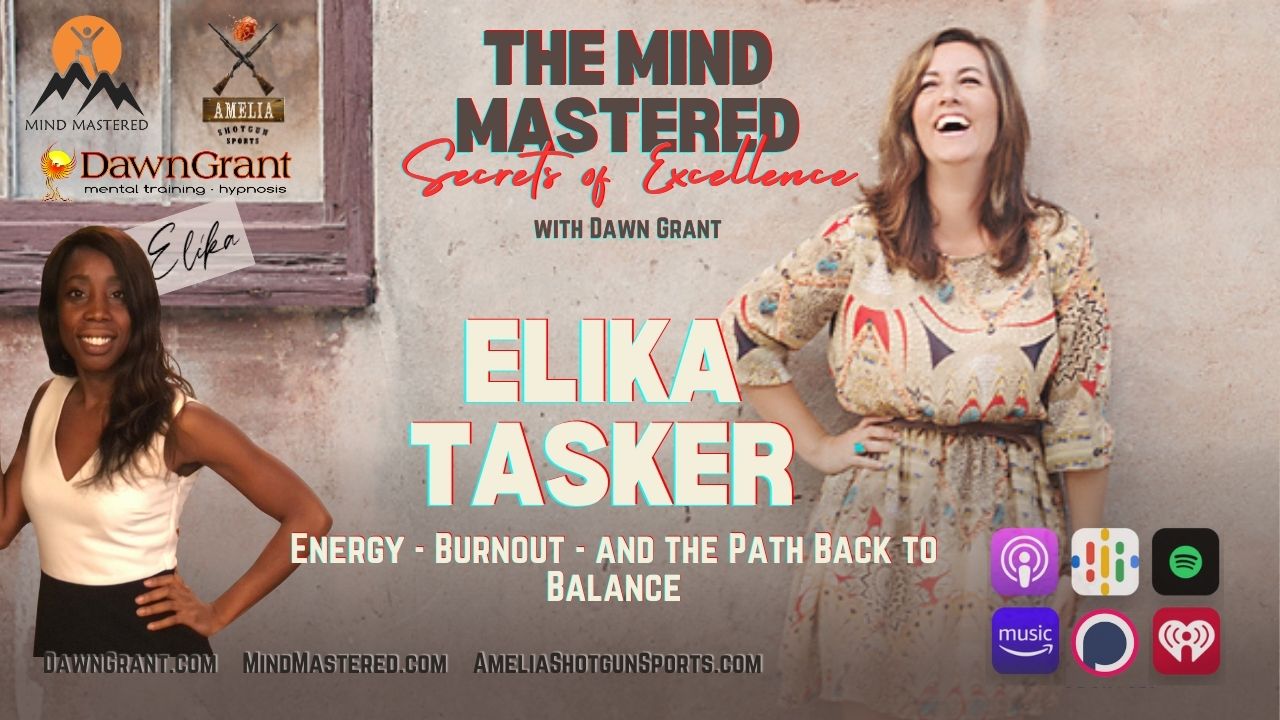
The Mind Mastered: Secrets of Excellence with Dawn Grant Podcast
Season 1 Episode 27
In this inspiring interview, Elika shares her journey from corporate burnout to becoming a wellness expert focused on energy management, human design, and holistic health. Discover how she integrates ancient wisdom with modern science to help leaders and entrepreneurs create harmony and avoid burnout.
Follow Elika on Social Media.
All contact information is provided in the podcast.
Visit https://dawngrant.com/pages/free to grab your exclusive free resources—hypnosis audios, mental training tools, and even a golf cart at her club!
Podcast Transcript:
Dawn Grant (01:13)
welcome back folks to the Mind Mastered Secrets of Excellence with Dawn Grant. I really appreciate you being here and for all of your great feedback and inspiration and I'm glad to be able to inspire you all with ⁓ some secrets of excellence coming from every angle of what makes a human successful
and whatever their endeavors are. ⁓ As you can imagine, I love the mental aspect of that, but there's so much more to it. But Alika, I've got here with us today, and I know that she is all about energy and focus and intention and probably much, much more. So thank you, Alika, for being here.
Elika (01:56)
⁓ Thank you for having me.
Dawn Grant (01:58)
Yeah,
can you give us your beautiful little summary? Like who was Alika?
Elika (02:03)
Yeah. Oh gosh. I know. Well, I, when you say that the first thing that comes to me is, Oh gosh, what is a name? Cause having just moved to Dubai recently, I just met another Alika and that's never happened in my whole life. So now you say that I'm like, I see it all very differently. Um, but I suppose Alika is somebody that is very passionate at helping leaders, founders and teams to manage their energy to avoid burnout. But I also.
Dawn Grant (02:15)
Wow.
Elika (02:30)
work with lot of spaces from hospitality to ⁓ wellness centers, clinics, and to create beautiful experiences that help people to optimize their energy, their wellness, and their longevity. So essentially, I'm somebody that is very, very passionate about managing our most valuable currency, energy, and I do that through a number of ways that sits under my wellness consultancy business.
Dawn Grant (02:54)
I like that you said our most valuable currency. So true, isn't it? I'm looking to really dive into that with you and see your thoughts on that. So why do you call it the most valuable currency?
Elika (02:58)
Yes.
Yeah, well I think on my own journey, which I would say is like burnout to balance, I came to look at how do we create harmony personally and professionally, because I'm somebody that really thrives in feeling fulfilled by creating impact in the world and the people that I work with are like-minded.
Dawn Grant (03:18)
Yeah.
Elika (03:34)
and yet we have done so much at the expense of ourselves and when we look at traditional wellness ⁓ that really
teaches us to focus on the physical body, what people see, you know, and therefore we focus on diet and exercise and that's what we're told to do and we tick that box. And that worked well for me until my second burnout. And in my second burnout, I'm like, ha, hang on a minute, something's wrong here. I left the corporate career to do something more fulfilling, to run my own business, but I'm here again. And that's where that deep introspection that I think every one of us needs at some point in our life occurred for me.
that inner work and personal growth. And I came to realize that the way to measure my success was through measuring my energy. And as Einstein said, everything is energy. And when you start to understand what energy really is, then you'll understand why it's so valuable to us. And yet it's measurable.
Dawn Grant (04:16)
Mm.
Hmm.
Yes, I love that. I love that. The mental aspect, which is energy too, right? Thoughts are energy. ⁓ I noticed, because I work a lot with athletes and athletes are so physical, right? Like everything you just said, they're so physical, they're about getting their muscles in shape and their mechanics and repetition of those mechanics and seeing a coach for better mechanics, like everything's so physical.
Elika (04:41)
Yes.
Yes.
Yeah. Yeah.
Dawn Grant (05:00)
And so those that haven't really been exposed to the mental game, ⁓ it's like a foreign concept that's invisible. And it's a lot of what you're saying to get them to just start recognizing that, you know, what energy is without getting spooked. It's so fascinating when you're doing it every day and you're understanding these invisible things. But do you come across a lot of people that... ⁓
Elika (05:08)
Yes.
Yeah.
Dawn Grant (05:29)
think it's woo woo or out there.
Elika (05:31)
⁓
Yeah, but I would say that in my work, I'm very much a bridge of ancient wisdom to modern wellness. And I'm very good at translating complex science like quantum physics and evolutionary biology. And I break it down into simple, realistic, sustainable habits.
that my clients can use in their lifestyle or that we can use in a space to create things. as soon as I, as soon as they meet me, I think that it's really helpful that I can break down the science and, know, it's just about speaking people's language sometimes.
Dawn Grant (06:01)
Yes.
Yeah,
yeah, for sure, for sure. I'm 100 % with you there. Well, let's rewind a bit. I want to get to know where were you born and what was life like for you and what were your thoughts as a child as to the direction things would go. So yeah, where are from?
Elika (06:09)
Yeah.
Yeah,
yeah. Well, so I'm British Jamaican, so Jamaican heritage. My grandma was born in Kingston, Jamaica. And if you know anything about Jamaica, it's a very powerful island. We have some of the most accolades for such a small island, Fastest Man, Longest Plain Song, Miss Jamaica. We have so many for just a small island. And all that is to say that I therefore inherited certain genetics. ⁓ Fast-witch muscles being one of them, that really helped me.
Dawn Grant (06:47)
Right?
Elika (06:49)
When I
was younger, that helped me so much. It helped my muscle mass today. I'm so activated with muscle, so I'm so grateful for those genetics. But I was born and raised in England, in the north of England, Leeds. And I essentially started my career as a very ambitious woman, coming from a mom that really had, I think, all immigrant parents. She was born in the UK, but still had that culture of, you've got to good education.
Dawn Grant (07:16)
yeah.
Elika (07:17)
and all that stuff. So I was really forced into academia, but I had a very good background in sports, which really helped me with the thing about sports. It's just brilliant for training your mind, driving or installing in you that motivation, that resilience, that ability to break down your muscles and rebuild them stronger and keep on going at it. And so I did have that. And so I noticed that when I joined my career in HR consulting,
I realized that I had a competitive nature naturally and had that natural, like that type A driven, ambitious personality all wired into me. And so, yeah, I think that was very much the start of ⁓ my journey. ⁓ Very young, ambitious, driven woman.
Dawn Grant (07:50)
Mm.
Elika (08:07)
But what I later came to see, which we can talk about later, is that I was driven by the wrong things. And that's part of journey with learning and understanding about how to manage my energy.
Dawn Grant (08:15)
Mmm.
What would you say those wrong things were?
Elika (08:22)
Yeah, I mean, I think a core one is a belief that I held and the belief ⁓ showed up when I found myself in another environment where I changed my environment.
to get away from a way of working. And I found the same pattern showing up. So I'm sure so many of your listeners can relate to these experiences where we change something in our life, whether it be a relationship or an environment, something. But yet we see the same pattern showing up. And in the work that I do, I talk about that's because you've never really changed your mindset. You've never really, you know, I call it rewiring the mind, like literally rewiring the mind to new beliefs.
and habits. And a core belief I held was you have to work hard, not smart. You know, we learn our behaviors, we're role modeled our behaviors as children through our guardians, which are typically our parents. And I saw how hard every member of my family worked. I saw my mom work really hard. I saw my grandma work hard. So all I knew was
Dawn Grant (09:11)
Mm, mm, mm-hmm.
Elika (09:31)
achieving and succeeding in life was hard work. And so I dragged that belief through all of my early career.
Dawn Grant (09:40)
Right, right, right, right. And that is like a generational thing, isn't it? Or more pronounced in certain generations. Yeah, okay, right, yes. Yeah. I was getting my nails done yesterday and the ladies in there are from, I think they're Philippines, they're almost all from, they work, yeah, they're working seven days a week.
Elika (09:48)
Yeah, so in Germany it's also so in cultures.
Yeah.
Dawn Grant (10:06)
I literally was just thinking about this because I was in my brain, I was listening to a few of them talk and the shop is open six days but some of them do it from home. So I'm like seven days a week working, wow, right? But it's so normal for all of them, right? And then I had my hair done yesterday, my hairdresser, she was, you know, do you want to come in for your next appointment on a Saturday? I'm like, you work Saturdays? And she said, yeah. I'm like, how many days a week do you work? She said six.
And I'm just like, wow. First of all, I'm an entrepreneur, so I'm really never off the clock, so I get that part. But if I was punching a clock though, I don't know, I don't know if I would work that much, but people do. And what else are they doing with themselves in their lives is what started going through my mind. I was like thinking, they can't be taking care of themselves, right? Yeah, yeah.
Elika (10:39)
Yeah. Yeah. Yeah. Yeah.
Well, you can't, you can't.
mean, seven days a week. mean, there's a reason why we have the Sabbath day, right? Like there's, we're not machines, but even if we were machines, I don't know machines that don't have a period of time where they don't just rest or stop, right? Even if you put it to stop, even like, you know, look at your mobile phone. When it goes on red, you start running for the charger. And so, yeah, we're the same.
Dawn Grant (11:08)
Yeah.
Yeah.
Yes.
So you mentioned you've had two burnouts. ⁓ Define what you would call a burnout each time. Like how did you notice that and how did you observe it? And so what would you call burnout?
Elika (11:30)
Yes.
Yeah, I mean, there are so many different definitions floating around. I know the World Health Organization have come up with their own definition of burnout, which I feel like it misses a lot of the inner spirit of humans. I think it's very mechanical.
Dawn Grant (11:50)
Yeah.
Elika (11:52)
But I can tell you that firstly what it shows up as is typical symptoms like constantly falling sick, lack of motivation. You feel like your willpower is gone, like you might not want to wake up, you might be suffering from insomnia. That drive, that internal drive that you have in you to get things done just seems to be depleted. You're exhausted, anxious, you might have digestive issues.
anxiety, these are the typical symptoms. And essentially it feels like the wheels have come off you, like that up and go has gone. And so essentially what that is, is the physical body starting to say, I'm not going to give you any more energy to continue with what you're doing. And I have come to believe that's not just because your hormones are imbalanced or your testosterone is low, you know.
Dawn Grant (12:23)
Yeah.
Elika (12:43)
I've come to believe that when the human spirit, when our soul, our consciousness is being forced to do something that doesn't align with the truth of who we are, there has to be a way to physically stop us. And that misalignment of you going in one way and your spirit wanting to go into another way, and that those two kind of almost rubbing up against each other and having friction, that to me is the definition of burnout. So I've never met someone that's...
Dawn Grant (12:53)
Yeah.
Yeah.
Elika (13:12)
that's burnt out, that's not, that's like, absolutely love my life. I love everything that I'm doing. I'm amazing. And I'm burnt out. I've never, I've never met that person.
Dawn Grant (13:19)
No,
right, and from my own spiritual stuff, well I'm obsessed with spirituality of any kind, learning about literally a spirit world. So if I was to add to that a little bit, to me this spirit is aware of who you are and what you want to accomplish on this planet and your life purpose, but also you're, you know.
We all, like somebody might desire to be a doctor and somebody else might desire to, I don't know, travel the world. Like there's so many different things. so in my experience, you can have that desire and your spirit is aware of that and will like to guide you down that path towards what you desire. And if you are not day to day living and experiencing or thinking and believing what will help guide you down that path, you will feel yucky.
Right, like that's, yeah, and to me, if I was to then add that to burnout, so somebody who's on a daily basis, not doing anything towards what they truly desire to be doing, yeah, and then, and I feel like we interpret that yucky feeling as I'm just depressed and then let me medicate it or I'm just.
whatever sad or unmotivated and I don't really know, instead of using it as a springboard to then make the next decision that will get you out of it, like let's do something different. And it's hard when your energy's low, right? It's almost like a double edged sword, your energy's low so then how do you get motivated to then make that change? But I love the word inspired because it comes from in spirit, right? And you get inspired to action.
Elika (14:46)
this.
Yes.
Dawn Grant (15:10)
at this point in my life and it's probably been, I don't even know, five to 10 years that I feel that, right? And it's so much so that I can't even keep up. There's so many, I'm inspired to do so many things. I'm like, need 20 people and not 10. Yeah.
Elika (15:24)
Wee.
Yeah.
Yeah. I mean, there's so much of our journey where, for thousands of years, we lived differently to how we are today, where so many of us are disconnected with the inner wisdom that we hold. And, you know, we didn't have Google.
We didn't have podcasts, we didn't have books, and yet we navigated across the Sahara. We navigated through some really difficult situations that were required to keep us alive, to find food, all these things that we did. And so all of this, you know, I studied a lot of the ancient wisdom and all of this was like this connection, this deep connection within ourselves.
that was guiding us and with our environment through sounds and changes in our environment. And so we know that as primal beings, we are inbuilt with this, whatever you want to call it, like intuition, but we are inbuilt with a wisdom that keeps us alive.
Dawn Grant (16:27)
I love that. was, many years ago I read a book and I wish I remember the name of it and I don't right now, but it was a woman who went to Australia and got special permission to do a walkabout with some Aborigines, which is rare, know, they're very ⁓ ceremonial and ritualistic and all that. But she wrote a book about it and it wasn't even a very big book, but it was so fascinating. She was talking about like,
Elika (16:42)
Yes.
Dawn Grant (16:56)
you know, there's a basket weaver, there's a healer, there's the hunters, they all had their roles and when they were in their role, they were in the zone, right? They were magnificent at whatever they were doing, that that was their primary, so the basket weaver is the basket weaver and took pride in their work and like all these great things, but when she went with the hunters, ⁓ they were so present and in that moment and following
Elika (17:00)
Yes.
Yes.
Thank
Dawn Grant (17:26)
intuition, inner guidance, whatever, like they could see the smallest leaf that had been moved to follow and track an animal, you know, and she witnessed physical healing before her eyes from the healer, you know, of like a broken bone or something. And it was so cool. just thought, but that, feel like we all have that potential within us, right? When you're present. Yeah.
Elika (17:51)
We yeah,
we really do. mean, we think of the, you know, the doctor, the doctor would have been the person in the tribe that had to understand every single plant and how that plant could heal. But I mean, now, you know, homopathy, that person has, you know, tapped into that wisdom and has passed down. But we all have the ability to know which plant is poisonous. We all have the ability to sense into our intuition which way to go without a map. But it is a muscle.
And if we don't use the muscle, goes. So in my world, I use a tool that's called Human Design, which I've studied really for about nine years or so now. I find it a very brilliant tool, having come from a lot of HR backgrounds where we use things like disk profiling and Myers-Briggs. And I found that it just put people into pigeon boxes with data that was at best 50 or 100 years old. Whereas Human Design is a blend of science and ancient wisdom that creates a road map.
Dawn Grant (18:45)
Mmm.
Elika (18:46)
to your most authentic self. Essentially, with data that you give it, it creates a visual body graph of how your body is designed to give and receive energy. And I have found it so phenomenal because when I work with a founder, when a founder can get this clarity on who they are.
Dawn Grant (18:59)
Hmm.
Elika (19:03)
what they're here to do and how they're here to do it based on how they're designed to give and receive energy. It means that they can just use their energy so much more efficiently, which is going to avoid burnout, but even more so is going to allow the impact that they give to be so much more potent.
Dawn Grant (19:19)
For sure, I love that. I agree with you on those tests too. Yeah, is this something that you designed, this test that you're talking about?
Elika (19:21)
Yeah.
No, so
human design, the creator is a guy called Raoul and I studied under a student of his and I had just been studying it and it uses ancient wisdoms like the Jewish Kabbalah, it uses the Chinese I Ching, the Hindu Chakra system, as well as the pseudoscience like astrology and numerology, but as well as science, quantum physics. And because all of those just by themselves, as you can imagine, are so big. I mean, think about
the Hindu chakra system and you think about Ayurveda, the oldest healthcare system in the world. And just about that by itself or in the I Ching, if you think about the Meridian lines that the Chinese acupuncturists use to know where to their needles. all of the astrology, can just, you know, it's huge. All of these are phenomenal resources just by themselves. And so what human design does is it puts all of those into a pictograph.
which represents your visual body and how your unique body is designed to give and receive energy. And then people like me, we study it so that we can help people to not just read it and know, but to integrate it into their way of living. So they're living by their most natural, like, authentic, virtual selves. Yeah, it's really important.
Dawn Grant (20:36)
love that. Mm-hmm.
I want to do it. That sounds cool. I'd love that. Wow. Okay, so you're in England and you are ⁓ in the academia and do you end up going to college or anything?
Elika (20:42)
Yes, yes, that's going to be very design reading for sure.
It really is.
Yeah.
Yeah, I did all my schooling in England and went to university there and then ⁓ I started on a graduate program having done my HR work placement and then I went from there to working in recruitment for years and moved into management position and then I got
Dawn Grant (21:20)
I'm curious
though, what were you studying? I want to see how much you've changed.
Elika (21:23)
⁓ I
studied business with my CIPD, which is the HR professional qualification. Yeah, so I wanted to be a business woman. I came home, see my mom in power suits in the 80s. know, there was a part of me that wanted to be a chef because I loved food. But then I remember just going, but you won't get to work soon. you were that I can tell I was influenced.
Dawn Grant (21:26)
Okay, yeah.
yeah.
Elika (21:47)
Yeah, and so I got a company transfer wanting to travel and see the world. I got a company transfer and moved to Singapore in 2012 and then started developing my career, the same career in Singapore. And then I moved through essentially multiple consultant roles into director role. And then I left with corporate burnout over 10 years ago. I left my career with corporate burnout.
and became an entrepreneur. And I started firstly with my executive health coaching business, knowing that all my clients were burnt out and so I could immediately help my existing clients. Yeah, my own burnout sent me looking for answers. And so I studied at the largest nutrition school in the world. And ⁓ when I studied all these different dietary theories, I was like, my gosh, I've got to help. You you go, I'm going to help the world. I'm going to save you. You don't know the food is killing you.
Dawn Grant (22:20)
Yeah, right?
Yeah.
Elika (22:38)
So I went through
all of that where it's like you can't eat anything at dinner party and to, okay, let's calm this. And then I opened Singapore's first refined sugar-free whole foods organic restaurant in 2015. yeah. And so essentially I just wanted a place that was safe for my clients to eat the food that I was telling them to eat. Let me just show you what we eat. Let me just make it for you.
Dawn Grant (22:50)
⁓ wow.
Yeah, right? Hey, I get that.
Elika (23:04)
So I did that, but a restaurant is, you know, it's not an easy thing. It's the hardest thing that I ever did. And with the running of the operations and running my coaching business and the limited belief that I held, I ended up having my second burnout.
Dawn Grant (23:08)
Wow.
Elika (23:20)
Um, and the second burnout was really difficult. Um, I was, you know, personally, my relationships going through so much. Um, I was like, you know, not in tune with my inner world. So I was just trying to push through and hustle. Um, and yet have this amazing business that I knew I'd started to really make a difference for others in the world. And so it left me very dumbfounded how I could, you know, have left the corporate world and the well-paid six, six figure salary and, and be doing something that I thought.
Dawn Grant (23:32)
Yeah.
Elika (23:48)
would help others and it would be coming at such a great expense of myself. But it was beautiful because as everything is meant to be, it was there to ask me deeper questions about myself, the impact I wanted to make in the world and how I wanted to do it. And those deep questions are pivotal now to the work that I do when I see people moving forward at the expense of their health or expense of their relationships or expense of their wellbeing generally.
Dawn Grant (24:05)
Yeah.
Yes, yeah, yeah, Well, how many years did you have the restaurant?
Elika (24:23)
Five years, yeah. So it ran for five years after my second burnout. I took some time out and I decided to ask myself those deep questions because I could see everything. I could see I had all this. Basically, it's like when you have paper success, like I was on the front page of Cuisine and Dine with my dish that everybody loves and had people queuing out the door. So that nice problem where they're queuing out of the door because they can't get a seat. And yet...
Dawn Grant (24:24)
Wow.
Elika (24:51)
I was completely dead. I had the most amazing customers. I remember this experience where I would look out at my customers and I would go, I'm so grateful that they see what I've been trying to do. And I'd look up behind my operations and I'd be like, my God, what are these? It was like this.
Dawn Grant (25:01)
Yeah.
Elika (25:08)
But anyway, ⁓ I went looking for answers and I actually spent a lot of time with indigenous. So I spent time. I learned from the Maoris in New Zealand, the Aborigines in Australia, then spent three months in Costa Rica with the plant medicine, really understanding that world. And then I wanted to go to my own route. So I learned from the Rastafarians, which are so much the caretakers of Jamaica. Then I spent time in Karela in the south of India learning Ayurveda. And I'd studied Chinese traditional medicine now for about 12 years. So I came back from that journey.
with very clear answers and for me it was that the West and my Western education and upbringing had been teaching me that health and wellness is all about the physical body like what people see your muscles your tissue and therefore you just diet and exercise and then you're healthy and what they were teaching was very different they were all saying the same thing which in multiple ways was take care of your mind and have a sense of purpose like a contribution
And so you could see this and you can see now in indigenous populations, and when we look back at tribal times, how the mind and how it worked and how you calmed the mind, got out your mind, and all of these things, and then a sense of purpose that every single member of the tribe had. And that's what they were teaching. And so I remember coming back and going, I need to bring this into everything that I did. And under the influence of the plant medicine, I'd already been told that the restaurant wasn't my path.
And I came back and I remember thinking I've got six months and then I either sell or I close or I don't know, I disclose if not. I had to, and two buyers came along and I was so fortunate. And when the buyer came along, I knew it was like, it was almost like the universe going, we'll help you make it easier. And so I sold the restaurant and as I handed the keys over two weeks later, COVID hit. So it was very divine.
Dawn Grant (26:53)
Well.
⁓
Elika (27:03)
Yeah, it was very, very led and I'm so glad that I followed not just the whispers of my soul, but the whispers of my soul that resonated with the information that I was getting as I was going into my own journey on personal growth and asking myself those deeper questions. And of course, like many people that, you know, want to leave something that they feel is is crushing them.
There were many reasons why I wouldn't want to close down a restaurant that I'd spent five years in when I'd already come at such an expense of my own health. There were so many reasons why I shouldn't stop now, I should keep on going. And we all will find our story. But the truth is, the soul will always continue to tell you when you're going the right direction. And our job is to listen to our inner wisdom.
Dawn Grant (27:47)
I'm right.
Elika (27:51)
So yeah, so that's pivotal to what I then did when I sold the restaurant. I started my signature program, the Health Concierge, where I decided that I was going to focus on coaching the top 10%. So I focus on founders and leaders who want to create a big impact in the world, but tend to build great businesses at the expense of their health, which I could relate to.
Dawn Grant (27:51)
Right.
⁓
nice.
Elika (28:14)
and bring them back to their most authentic self, their true self, and help them to realign so that they're now building and creating from the most authentic version of themselves, which will never burn them out, which will never put their relationships at jeopardy, will never put their health at jeopardy. So I do that. And then of course I consult in spaces where they might need anything from creating a menu to a wellness program or a retreat. So it's very vast, very good.
Dawn Grant (28:26)
Right.
Nice,
nice, nice, nice. I think that's all really cool. ⁓ Opening up that restaurant so that you could help your clients eat what you are suggesting. ⁓ I get that, because granted over here in the States, ⁓ fortunately there's been some progress with what's available to eat that's not toxic or whatever. Some, not even.
Elika (28:44)
Yeah.
Yeah. ⁓
Yeah. Yeah.
Dawn Grant (29:06)
And that's made
Elika (29:06)
Yeah.
Dawn Grant (29:06)
life a little bit easier. But as somebody who's been health conscious for like 15 or 20 years, it was really hard for a while. And you really had to be diligent. There was nothing easy. There is nothing convenient about it at all. And for a long time, I've thought one day I'm gonna have a chef just to make my life easier. I'm like.
Elika (29:26)
Yes. Yes.
Dawn Grant (29:28)
Learn this info, because I don't want just this chef to cook whatever. It needs to be clean and healthy and taste good. So yeah, would have loved for you to open a restaurant next to me.
Elika (29:32)
No. Yes. Yes.
It's been an amazing experience.
Yeah, because I know it's still in the US, you still have food deserts, but the truth is, like, for me to have done what I did with my restaurant, you know, I was following the trends from New York, from LA, those whole foods movements that weren't salads. see, with my concept, I mean, I still, there's still nothing that exists as disciplined as I was in Singapore. I had a ban on refined sugar. I had a ban on anything that could take contained a preservative or anything artificial.
That means for a restaurant, you can't buy the plant-based melts today. They all have preservatives and stabilizers. You can make tomato ketchup. So we were making everything from scratch with the sweeteners as raw honey, maple syrup, cinnamon or coconut or gula malaka. This was a sweeteners or fruit. Yeah, yeah. It was some effort, you know, and then to train the chefs in a way where, you know, they all had other quick fix way of doing things, but the quick fix...
Dawn Grant (30:11)
All right, for sure, yeah.
Sounds like a dream. I would love that. I would love that.
Yeah, for sure.
Yeah.
Elika (30:36)
women things meant a shortcut, which didn't mean that my clients were going to be eating completely whole and clean food. yeah, it was a labor of love, to be honest, but it was so beautiful.
Dawn Grant (30:48)
a lot of work. ⁓ are you sticking to all that clean eating yourself and your life right now?
Elika (30:55)
Yeah,
I practice, you know, and it's something that I inform all my clients to. practice 80 20. So in the wellness industry, it's very easy to get what we call orthorexia, which is the fear of eating something bad. And I can tell from my, when I very first started, when I was studying, like I was literally like a of gluten, cat of dairy, cat of sugar, of preservative, and it was just like, what can you eat basically? And then what happens is you stabilize and you also clean out your body a little bit.
Dawn Grant (31:06)
Hmm.
Yes. Yes.
Elika (31:23)
And then what happens is because you're not putting all that junk into your body, because your body just rejects it anyway, your body has this light ability to take a little bit of it. And that's the 80 to 20. So the 80 % is to me is the whole foods, minimally processed, things that your great grandma would have been eating that were grown, moving, or in the water of the land. And 20%, whatever I want, because if you enjoy the good chocolate cake or the glass of wine or whatever, that's your thing. Whatever your thing is.
Dawn Grant (31:27)
Yes.
Yeah.
Yes.
I know right?
Elika (31:52)
But to me, even the 20%, I have it really good quality. If I wanted a croissant, I'm not going to go in Starbucks and get a croissant. for that.
Dawn Grant (31:56)
for sure.
Exactly. Yeah, you
definitely become more of a connoisseur of what that 20 % is going to be. And that first bite, if it's not like really good chocolate cake, I'm like, no, it's not worth it.
Elika (32:04)
Yes, that's it.
Oh, don't do it. This is so funny that
you say that because this hasn't happened to me for a while. But yesterday I was actually going to a friend of mine's, she runs a really beautiful wellness center here in Spie and she had this big bowl of sweets, which no wellness center should, but they're all chocolate candies. All this, I would never have that home. And so when I see it sometimes I'm like, oh, why not? So I looked up what looked like, it looked like a chocolate eclair, which I think I've never, I haven't had, I can't remember the last time I ever had a chocolate eclair. It's at least a day.
Dawn Grant (32:32)
Yeah
Right.
Elika (32:39)
So was like, ⁓ yeah. And I opened it up and put it in my mouth. And as I started to crunch, I was like, it was disgusting. I literally had to get a tissue and spit it out. And then had this little grin to myself and I was like, somebody else would have found that so delicious. And it was disgusting for me. Like, I'm not it that much. The amount, the high level of sugar and the cheapness of the chocolate inside, because I loved it. was like, wow, this is not chocolate. I literally just spat it out into an upkeep.
Dawn Grant (32:49)
Yeah.
Yeah.
the wax, yeah, that waxy guy.
Elika (33:09)
So yeah, you don't need willpower when you train your body to calibrate to higher quality. I eat chocolate every day, but it's not calories.
Dawn Grant (33:14)
Yes.
Yes, yes, I'm with you. I'm with you on that. And at the same time, I would say we don't have to be perfect, meaning there's a coffee shop down the road that opened up a year ago. But at first I would dabble in there, went here and there, but for maybe a two week window over the last year, my husband and I went like three or four times a week and they make from scratch goodies, right?
And so it might be carrot cake or chocolate. And we had a treat, a treat every day for like four days for two weeks. And then we were both like, this has got to stop. But yeah, we're back on track again. it's the bread too. Like so many restaurants serve bread. ⁓ I might say, sometimes I can tell by looking at it, like if it's worth it. ⁓
Elika (33:48)
Yeah. Yeah. ⁓
Yeah, yeah, yeah, yeah, yeah, yeah, yeah, yeah, yeah, yeah, yeah,
Dawn Grant (34:12)
If it looks worth it and I sample it and it doesn't taste worth it, we just don't eat it. But if it's amazing, it's gonna be part of that 20 per se.
Elika (34:16)
Yeah, but you know,
for me it's always the two, flour and sugar. So when I look at bread, which honestly, let's be honest, bread is like people's most hardest one to remove. But like bread, I can just look at it and know. And you know, everyone's experienced now because sourdough is really popular, but I keep on reminding people that all dough was fermented like.
that's all dough with sour, all bread with sour dough, unless it was like flat bread, like we get in the Middle East, you know, they are very good at flat breads. But you see that sour dough and it's almost like the color is a little bit, it's like not white for sure, it's like off white. And then you see holes that it's made in the bread. Like when you see that, you know that's good bread, right? But then when you look at someone serving you scrambled eggs on toast, whatever, and it's like perfectly square white bread with perfect crust, why?
Dawn Grant (34:56)
Right. Yes.
Exactly. ⁓
No.
Elika (35:11)
Don't pull that, just don't, don't eat it. Say you get that precious local bakery that's like, or your pizza that tells you we ferment ours for 24 hours and you actually, and it looks like they have, then have it then.
Dawn Grant (35:14)
We have.
⁓
Yes, I'm on board with you. ⁓ my gosh. The hotels in the States are horrific for food. my gosh, ⁓ the eggs, the fake eggs, whatever they are. They're so horrible. So when we went to Italy earlier this year and
Elika (35:40)
I have so much work to do with hotels, they're the worst.
Dawn Grant (35:54)
That was one of my husband's favorites. He was jaw dropped. Like the hotel gave you free breakfast, but it was amazing food and like every kind of fruit you could imagine and real eggs and this smorgasbord of amazingness. you know.
Elika (35:55)
Right.
And it's just,
it's honestly about creativity because, I also work with hotels on the menu creation. And it's so sad because the truth is, is that everyone's so segmented in the hotels that nobody understands the bigger picture. So they think that they just buy all this stuff and then it's cheaper than what people actually really want. When people just want to eat whole foods, they want to eat real food, it's not really processed. So when they want gluten-free, they don't need the factory gluten-free bread.
that's just as processed, what happens to be gluten free. When you have rice, you can make rice flour, you have millet, you have all, I mean, there's only three grains that even contain gluten, right? So, it amazes me when I go into hotels, like I can be in Thailand, you can go into a hotel and they have almond milk, oat milk, soy milk, but no coconuts. And I'm like, but the coconut trees are all there. How can you not have coconuts? It's bit cheaper for your staff to grab all those coconuts
and to put it in the blender and then you make that's cheap. Like if you want to save costs, like, know what mean? You can blend it in the time that they have to unload the lorries. So it's just about, it's a combination of the education of what is it that people want when they say gluten free or they want dairy free. It's education and a level of creativity. And so hotels need so much support with this because they just don't have it.
Dawn Grant (37:38)
You're reminding me of I've been to Jamaica many times and have admired the locals and the little.
I don't even know what you call it, the little spots on the side of the road where they're selling the fruit. so I always like talking to the locals and learning when I go to places and they're like fish and fruit, know, mangoes, fish and fruit. And everybody's skin looks so healthy and they're all thin and they look healthy and they have energy. ⁓ I just think, eat what's there, yeah.
Elika (37:50)
Yeah, oh yeah.
They just eat on the house.
And when we go in supermarkets, just need the, honestly, we just need the first two aisles. Everything else is life, especially in the middle of the supermarket. You want to save food, just do the first two aisles.
Dawn Grant (38:20)
Yeah.
Yeah, I have a hypnosis audio for healthy grocery shopping that literally gives hypnotic suggestions to only shop the perimeter. That you're driven to it, you want it. Yeah, so.
Elika (38:30)
Oh, that's so cool. Yeah. Yeah. Yeah. Yeah. So like when it
comes to food, you know, and this was so important for me in my restaurant because I had a ban on salads because I wanted people to understand that healthy, you Google healthy and you see all these images, that doesn't define healthy for about 60 % of the population. 60 % of population, they don't call their foods that their grandma grew up with, traditional foods, a salad.
And so when you push that in front of everybody as the label of healthy, no wonder you want to eat donuts and pizzas and I would, because I love food. so, you know, again, we can do beautiful salads, of course, with like roast pumpkin inside or warm foods and comfort foods. But I really had to have a ban on salads because I was like, no, let's go with all of what people to see as comfort foods. I want the tacos, I want the burgers, I want the curries, you know, I want the shoes and have every single ingredient be whole foods based.
And so that's what we did. And then the cakes as well. had carrot cake, I had chocolate cake. had avocado, which was my key lime pie cake. had all, but they were all gluten-free, dairy-free, refined sugar-free. And so I just focus on the It's all possible. bless you. But it's all possible. But it requires understanding of, you know, ingredients and a bit of creativity.
Dawn Grant (39:41)
You're my dream. Can you, I wanna hire you.
Yeah.
Wow, that's, I mean, that's a small amount of what you're doing now, right? Yeah.
Elika (39:59)
Yes, it is. is.
Honestly, it's the smallest amount now. Like I'm an expert in nutrition, but most of my, so I have a framework called the energy reset recipe, which I've built over the last 10 years. And it's the framework that I use to build programs for companies, to build retreats, and also to guide my clients that are with me for 12 weeks on the coaching and lifestyle program we have called the health concierge. So like all recipes, it has four main ingredients. And the first is nutrition, where we teach them heritage eating.
Dawn Grant (40:03)
Yeah.
Elika (40:27)
So again, going back to your great grandparents' foods and eating that in abundance. Then it has movement, which is not about subscribing to gym membership. You can if you want, but it's about how do we create a lifestyle that for you has movement every day involved in it so that energy can move through the body. And the third pillar is purpose and relationships, where we use the human design. So we will do your human design chart and then we will use that as the blueprint to find out where...
You're supposed to thrive in relationships that give you energy rather than take energy away from you. There's energy vampires where your, your work is not aligned to the superpowers that you have that shows us in your chart. So we use the human design for that. And the last pillar is the mind and self care, which is predominantly about sleep hygiene. And so if you haven't had somebody like me, that's upgraded your, software of your mind, you're going to find that you've got a lot of glitches in your software. And especially for founders, if you're trying to run a business,
Dawn Grant (41:19)
Yeah.
Elika (41:22)
and you've never had done any mindset work. You've never had anyone really challenge your beliefs or upgrade them with more empowering ones. You're going to have a lot of problems because especially as founders, like there's nothing like a business to throw you into personal growth.
Dawn Grant (41:35)
Right? ⁓
Elika (41:36)
Right? It challenges everything.
You don't like sales? You better learn. You don't like, you don't like people, do you? no. Customers, no. Admin, no. HR, no. Finance, you don't like them. Like, you know, so every part of us has to grow. And so that's, you know, essentially the four pillars that I use. And by doing that, what it does is it creates harmony personally and professionally, because the individual is being assessed in all of the areas of their life that take energy away from them.
Dawn Grant (42:06)
Yes, yeah, yeah, I could see that. What kind of mindset work do you do? How do you help people change their thoughts and beliefs?
Elika (42:14)
Yeah. So I like to start particularly on a session with my clients where we, I call it the soul wound session, where we go back to the first early memories. There is a really brilliant book. I can't remember her name, something called soul wounds. And it's funny. I found the book after I was doing this work. So then I was like, my God, she actually gives me five cold soul wounds. And I had like about 10 or so, but they're
So I like to go back to those very early days. So the first seven years of a human brain is where most of our conditioning is happening, you know, through our guidance, typically our parents and our teachers, our religion, our culture. These are all layers that are put on. Human design, we call it the conditioning. And so I like to go back to those early days and discover what those soul wounds are. So we discover these soul wounds, these experiences that we have that really hurt us, but really shaped us like sharpening an iron. They created something in us like our values and what we stand for and what's important to us.
Because a lot of people that I work with, they're building businesses or they're building other people's businesses, but they're doing it and they're going against this inner wisdom that they have inside of them, which is their values. But that's because they never really refined what those were. And especially if you're building a business, which I see as an extension of your soul, you want to be super clear on what that is. So when we go back to the soul and the experiences of the soul and what we learned from those experiences, then we start to see, my God, this is so important to me now.
right so for example soul wounds is abandonment and because that's a deep soul wound for me the the i the amount of self-worth ⁓ that i have to do and like showing up for myself and like you know putting myself in situations where i'm like
Dawn Grant (43:38)
Yeah.
Elika (43:54)
If you, If they haven't got me, I got you. know, that type of energy. The amount of work that I have to do so that I'm never in a situation where I self abandon. And it's so easy for me to self abandon. I've got like a Libra moon and a Libra ascendant, which is all about harmony and relationships. So I'm the first person to make sure everyone's okay. I've got a fire sun sign up part of me, which is like, let's go, let's go, let's go, let's go. And so I'll keep fighting with that, that part of me that just wants to go and do and achieve. And then this part of me that's like,
Dawn Grant (44:11)
Right.
haha
Elika (44:23)
making sure everybody's okay with it. And so that self abandonment became something for me that was part of my work, but that's because one of my core wound was abandonment. So that's where I like to really start the mindset work from. And from there, we discover what their beliefs are, where they formed those beliefs, and then we can wire to them. Now, because I've been doing this work for a decade, when somebody gives me a belief, like some of my clients say, Noorlicky, you don't understand. I'm like, let me tell you about, and I'll give them a...
Dawn Grant (44:33)
Right.
Ugh.
Elika (44:52)
Let me tell you about Jeff, who's got four children, a wife, runs one of the largest clients in the world. Like literally I have these examples of people that I just love in my life. And I'm like, so is it a fact or is it a belief? Because if I can show another one of my clients that is, then that means it's a belief. And great, because if it's a belief, we can upgrade the belief to a new belief. It has to be one that you believe, but we can upgrade it. And then that's what we do. That's when we do the work to upgrade.
Dawn Grant (44:56)
You
Right.
Yeah.
Right, right. And how do you do that? Do you do a meditation suggestions or hypnosis suggestions or repetition?
Elika (45:27)
No, I mean,
looks different for everybody, but, you know, inner work can be different for everyone. So I love visualization, which, you know, the sports industry really helped us to bring that mainstream. So I love that idea of like closing down the conscious mind that's overthinking and getting into your subconscious and actually visualizing your life, like being in more of a meditative state and visualizing and feeling and using all your senses. What do you see? What do you feel? What do you smell? What do you taste? And all of that and seeing what comes out.
So I love that because that taps into the higher self of us. I love just giving you facts, right? So if you've got a limited belief and it's just a belief, like I had a limited belief that I had to work hard, not smart. And so that meant when I was running a restaurant, nobody can run the restaurant apart from the owner. But then I found three or four restaurant owners that seem to be traveling all the time. I love going in and I'm like...
Dawn Grant (45:56)
Right.
⁓
Elika (46:21)
How do I do it? So I had to sit down with them and I had to say, I have a limited belief that I need to overcome. And I know because you're sure how do do it? So sometimes I'm the person for my client. I'm like, this is the fact that, or this is a person or this is an example and giving them they can no longer. So then we go, so what's in the way of you knowing that that's true for you. And then sometimes it's so obvious. My mom told me this when I was younger or this happened to me in my last relationship. I thought I had to do, sometimes it's as simple as that.
Dawn Grant (46:27)
Yeah.
Yeah.
Yeah. Yeah.
Yes.
Right, yes, for sure. Yeah, so, all right, well let's go back a little bit. So you had the two burnouts, you started this new business that's doing great, you're in Singapore, now you're in Dubai. How do you decide where you're living? Because these are all great places. And also the places that you've traveled when you were finding your path.
Elika (47:06)
Yes.
Yeah.
Hmm.
Well, you know, on this journey of my own personal growth, I've had to connect with how I feel about something and our feelings, let's say our emotions, our emotions, energy in motion. again, energy, energy that moves through the body, which is signals from the body. So what does anger represent? You know, it's a buildup of tension that usually probably starts with frustration and then gets to that point, but it makes you change things. So anger represents change.
Dawn Grant (47:43)
Yeah.
Elika (47:45)
What does
Dawn Grant (47:45)
Yeah.
Elika (47:46)
sadness represent? So sadness again, feels low frequency in the body, it brings you down. But again, it's there to signal something, right? I remember experiencing grief the first time when I went through a divorce and I was like, I never experienced grief before. And then somebody helped me reshape it when they said it's just love looking for a new home. And I was like, yeah, that home had to come to me because that's where it was needed. So I like to really just anchor into
Dawn Grant (48:04)
Nice, yeah.
Elika (48:13)
emotions as a way of signaling where I'm going and what I'm doing and providing that inner wisdom. So I wasn't deep into this work at that time. When I first started, I wasn't really deep into this work. so when I had my second burnout and I went traveling around the world, that took
what I would say my personal growth from surface level, where I was just about diet and exercise, food, exercise, it took it deeper into going exploring my inner world because I did Ayahuasca and under the Ayahuasca, what that does is it really alters your consciousness so that you can see a higher level of consciousness that you've never tapped into before. And once you've seen and experienced that, you understand that more exists outside of the 3D world that we experience every day. And so when I came back with that,
Dawn Grant (48:53)
Mm-hmm.
Elika (49:01)
Then it's also like your pineal gland is open. Again, this is a muscle that you can train. Your pineal gland is open. You're much more intuitive. You're much more in sense with your, your environment and your own feelings and other people's feelings. You're much more empathetic. And so I use that now as a wisdom to guide me. So for example, when I came into this year with Singapore, I had such a beautiful year last year. had a lot of success in my business and I felt personally a lot more.
just very confident in who I am and what I'm here to do. I'd really deep my own integration into my own human design. And I was seeing how by following my own energetic blueprint, it was really the pathway of my own success. And so I came into the year and I was like, so what to do next? And I could feel that the emotion of joy and excitement for doing that in Singapore wasn't there. And that was my first sign. So then it's a question of then where. So
Dawn Grant (49:32)
Yeah.
Elika (49:55)
When you ask the question, starts to show up. So Dubai kept on showing up, showing up, showing up. And then I start to question and you get in your head and you're like, ⁓ then people say, no, you can't, the weather. I don't know you'll like it, Alika, you love nature. There's not much and all these things. But you feel, and when they were saying this, it wasn't resonating with me. I might need to turn the light on. Can you see the light dimming?
Dawn Grant (50:13)
it a little bit,
Elika (50:15)
And so, so again, I was checking in when people are sharing this with me because people can say facts. Yes, it gets to 50 degrees in Dubai. Yes, there's not as much green as the leaker lights. Yes. But when the facts were hearing me, my feeling was I still want to try. So that tells me that my inner wisdom is saying that's maybe not true for you. And so I decided to get on a plane and go to Dubai and just see and explore. And that was in May and I never went back. And this week,
Dawn Grant (50:32)
Yes.
Nice.
Elika (50:43)
I
signed for all of my stuff to be shipped over to Dubai. And that's how I live my life. Yeah, it's not easy because your mental brain wants to come in and give you all the reasons why you cannot, cannot. for me, my desires come from my heart and I use my brain to figure out the how. And don't use my brain for desires anymore.
Dawn Grant (50:46)
You
Yes.
For sure.
Yeah, that you remind me of it was 25 years ago or so I got divorced from my first husband. And when I was and I had two young kids out, know, single mom in my own home. And I remember, you know, just just from my own life. But I couldn't I remember not being able to decide should I buy a lawnmower or should I I hire the local boy in the neighborhood to mow my lawn? And I remember a decision like that being difficult for me.
Elika (51:12)
Yeah.
Dawn Grant (51:33)
and I had what I called a panel of experts, I had my mother, my sister, my best friend. And at that time in my life, I would call one and hear whatever they said, and I'd hang up and call the other, and I'd hang up and call the other. And I was going through a lot of drama, going through that divorce and trying to raise the young kids with him and all that. And so I'd call them for everything. about a year or two into doing that, I realized I started calling
The one that I knew would tell me what I wanted to hear. And that was my first light bulb moment. Like Dawn, you already know what you want. You don't need to call that person. I still did for a little while, but that helped me get to a place where I started paying attention to myself, my inner voice. And it was through that of knowing.
Elika (52:11)
Exactly.
Yeah.
That's it.
Dawn Grant (52:26)
knowing which one I was gonna call, because they were gonna tell me what I wanted to hear. And I'm like, you already know what you want. Yeah.
Elika (52:28)
Yes. Yeah. Yeah,
I hear you. And I think it's beautiful to have it. We call it the Board of Advisors. I think it's good to have that. there is, you know, in human design, we call it inner authority. Each and every one of us in our energetic blueprint, how we're designed to give and receive energy, has our own way that we're designed to make decisions. And the problem we have is all of us have been told through our education system that it's the brain and it's not.
And so, it's our gut, you know, and we now see all the science that's happening around understanding the gut. 70 % of the serotonin is in the gut, the immune system is in the gut, and we're understanding the connection of the brain and the gut through the vagus nerve. But before we had that, human design was already saying that some people are driven to make decisions by the gut. Some people are emotional in how they make decisions, their emotions, the feeling of something. And we see that a lot in the last veno culture. Some people are what we call splenic.
Dawn Grant (52:58)
Right.
Yeah.
Elika (53:25)
So the fear or the intuition helps them to make decisions. And so we all have these unique ways of how our energy is designed to actually make decisions. And so again, if you're not first learning how to understand you as the most important thing first, that can be really difficult. Just bear with me. I want to just this light on behind me.
Dawn Grant (53:42)
Yeah, yeah, that's fun.
Elika (53:46)
Yeah, okay. ⁓
Dawn Grant (53:47)
Much better.
⁓ My husband now, this was a few years ago, but he said to me, I don't know why you asked my opinion because you're gonna do what you wanna do anyways. And I said, you're right. I ask your opinion to help me feel like it's like a weighing, like when you were talking about Singapore versus Dubai, like there is a feeling and so.
Elika (54:08)
this.
Yeah.
Dawn Grant (54:14)
And that's why 20 something years ago I'd call my little panel of experts because they're giving me different input, different ideas, and I'm feeling which, and it might be pieces of what one says, it might be a lot of what one says, or it might be nothing of what one says, but I'm feeling myself through that when people are talking to me and it helps me, again, to exercise that muscle, but also be able to pay attention
Elika (54:17)
Yeah.
Mmm.
Yeah.
Spirit.
Dawn Grant (54:43)
because you can get to the point where you don't need to ask, you're already tuning into it by just thinking about it, how does it feel?
Elika (54:49)
Yeah. ⁓
It's amazing you said it because in human design, there is a character, there is a type of person that we see in some of the designs that they're literally designed to bounce things off someone first and that energy exchange is how they make decisions.
Dawn Grant (55:07)
Yeah, nice. Yeah. But you know, I would say I've evolved though. I'm not totally I still might bounce something off somebody but not to the degree that I used to and, and, and rarely anymore at this point. But that again, you know, I've been an entrepreneur for 30 years also. So there's a lot of decisions that have been made and a lot of practice. But and I'm older. Yeah.
Elika (55:16)
Yeah, for you. Trust yourself.
Yeah. Yes. Yeah. We learned that you just. Yeah.
Dawn Grant (55:32)
I'm 54 now, I'm reaching
that time where it's like, I'm gonna do what I wanna do and I know what I want. Right, exactly. Well, how exciting. So I love your story and I love your journey and I love what you're doing and that you're in Dubai and you're settling in there. I know, right? That's really cool and what a great bunch of ⁓ business people.
Elika (55:37)
Yeah, wisdom gives control. It's like, okay, I got this.
Thank you.
Yeah!
Yeah. ⁓
Dawn Grant (56:02)
entrepreneurs, executives that are serious about getting things done, right? So that's a great market for you, for sure.
Elika (56:03)
Very.
Yeah. Yeah,
it really is. And a huge market of burnout because there's so many people that are so driven. Dubai's got a culture of abundance. It's so amazing. It's one of the main drivers why I left from Singapore. ⁓ Both are very safe and beautiful countries to live in. ⁓ But it has such an abundance mindset that it's never about, can we? It's just, how do we do it? But
you know, with that comes people coming. You remember the old American dream, right? I almost feel like Dubai's got a modern day version of that. And so, you know, for someone like me, I come and it's so great because I can plug and play because I've established my products, my offerings and who I am and what I am. But there's a lot of people I think that are drawn here that don't have that clarity yet. And so they just work and work and work and try and figure that out. And I think that can be hard. And so when those lead, when those are leaders that really want to do good in the world, you know.
This is where I see I've got also another opportunity to support another group of people that are not channeling their energy in the right way.
Dawn Grant (57:10)
I was hired by a guy that lives in Dubai years ago and he was striving to excel in shotgun shooting sports, competitions and all that. But he hired me, I don't even remember, two weeks before a major competition that he absolutely decided he absolutely must win and he was not performing well at all. But the level of intensity, the level of...
because he would call me, he was always late for his appointments, virtual, video calls. He was a lot of times in the back seat, he had a driver and a car, ⁓ but the level I could see, the level that he was working and the level of stress and the level of juggling, whatever all that he was juggling with his work and everything, there was very little room for him to work on himself and yet he wanted this miracle.
Elika (58:05)
Yes.
Dawn Grant (58:05)
And I
just remember feeling like, I don't think I can get him there. And I hardly feel like that, but that man stood out. He was very unique in the amount of pressure and the amount of work that he put on himself while he wanted to take care of himself. And it just wasn't gonna happen. And it didn't. And then he was upset, but I just like, I don't know. That was far fetched that that was ever gonna happen.
Elika (58:11)
Yeah.
Yeah,
well the way that he had to take care of himself was the way that he didn't want to hear, right? And sometimes it's that, it's like give me the answers because I need this, but the thing is, it's like if you think the answer is the thing that you are saying, then you would have done it already and it would have worked, but it's something different and are you prepared for the difference? Are you prepared to do so?
Dawn Grant (58:48)
Yeah.
Exactly.
Elika (58:53)
A lot of people that work with me, always say, I'm usually the last port of call. You will have probably done easy, low hanging fruit. Maybe you would have got a nutritionist who tried to lose some weight. You'd have got a full trainer. Maybe you've done some therapy or you went and paid and got like cheap coaching that was never going to transform your life. And then you go, okay, I'm ready to stop trying to connect the dots myself. And I'm ready to do deep, deep, deep work. Okay, now you're ready. Great. Let's do it. Let's play.
Dawn Grant (59:00)
Yes.
Yes, yes, you're absolutely right. Because for me, I take people through what I call mental training with hypnosis to help them change the beliefs and patterns that they're subconscious. But consciously, you have to actively learn how to process information differently. I walk people through that process. And when somebody is so overloaded because of their schedule that they're skipping, they're not even keeping their appointments with me.
Elika (59:44)
Yeah.
Dawn Grant (59:45)
or they're
running late and they're like, sorry, instead of an hour, we're gonna only be able to do an hour to a half hour a day and then maybe he's taking other calls, you know, it's like, there was just, and he wasn't doing the work between the appointments, the work meaning working on how do you process this information differently? How can you keep yourself in the present moment, let go of the past, but learn from it, like all these things. But yeah, more than any other client, any other country in the world that I've worked with.
that person in Dubai really stood out as, and yeah, he could use you.
Elika (1:00:17)
Yeah, because.
Yeah,
yes, you'll find me for sure.
Dawn Grant (1:00:23)
I
know, right? Yeah, really, really cool. Well, I do wanna tell listeners that I have some free goodies and some opt-ins for whether it's Mind Mastered app or my mental training and hypnosis or my Shotgun Club Amelia Shotgun Sports. If you go to ⁓ dongrant.com forward slash free and ⁓ yeah, so Alika, please share your information, your contact information and such.
Elika (1:00:52)
I mean, the best place is my website, which is Alika, my first name, .co, so .co, so E-L-I-K-A .co. But I'm on all the social media platforms. Typically, I'm under Alika.health on there. So Instagram, Alika.health, YouTube, Alika.health, and then you'll find me on LinkedIn as well. That's where a lot of my clients hang out. I love hanging out on Instagram just because it's so easy for me to do it on the go, Alika.health. But Instagram, I'm really enjoying like...
Dawn Grant (1:01:17)
Yes, yeah.
Elika (1:01:21)
Doing my newsletter that I've got there now where I really talk about energy management and the difference between like traditional wisdom and modern-day wellness So I love LinkedIn for just providing more context. So yeah
Dawn Grant (1:01:33)
Nice, nice.
I can't wait to look at some of that myself.
Elika (1:01:38)
Yeah, you'll like it. Especially I do a lot of video content, which I think is sometimes helpful to to transmute the message across to people.
Dawn Grant (1:01:46)
For sure, I have the same experience, very helpful. And the fact that there's 60 seconds and you can get a really good tidbit of information to somebody and they're able to receive it. They're able to make time for 60 seconds. Yeah, yeah. Well, awesome. Thank you so much. This has been a great, fascinating conversation. I wish that you and I lived close to each other, because I'd be hanging out. I'd be hanging out with you, girl.
Elika (1:01:58)
And like, hold on, hold on, yeah.
Thank you so much for having me and thank you for all the listeners that are still on and listening. If I can support anybody in any way with anything that I've been saying, that's my mission. So yeah, thank you.
Dawn Grant (1:02:27)
Beautiful, beautiful, thank you.
Elika (1:02:29)
Take care.