


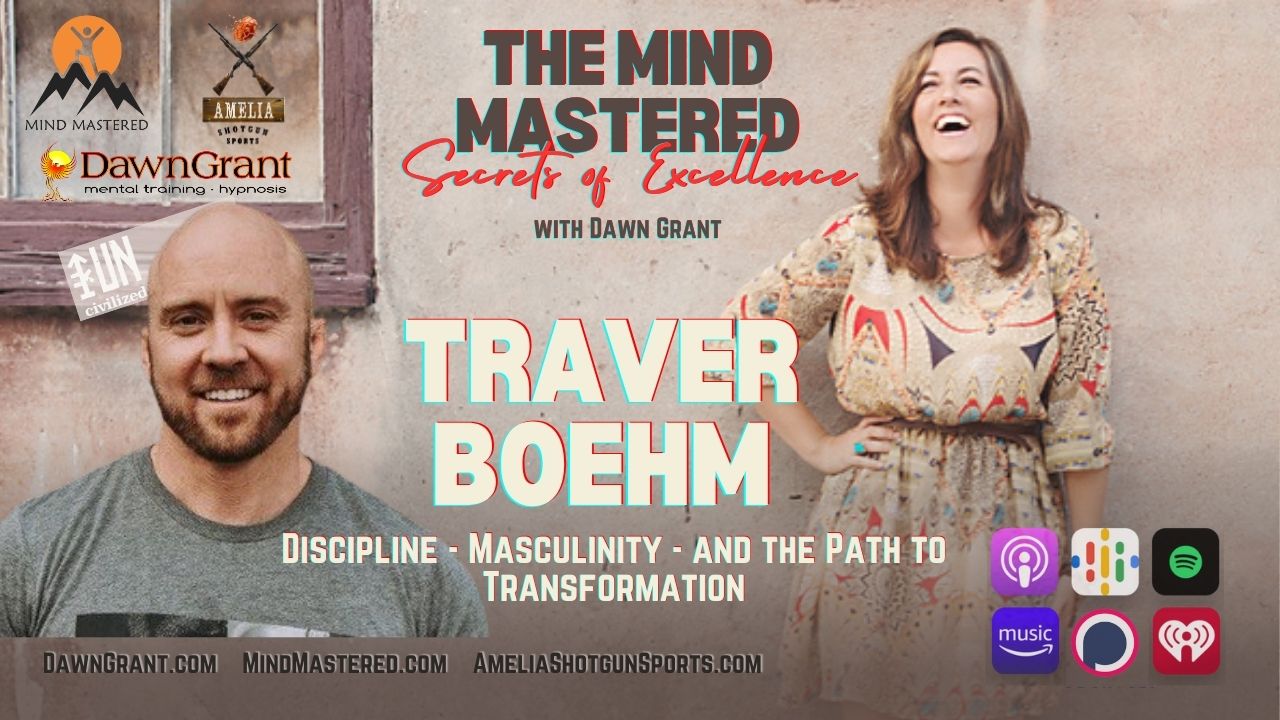
The Mind Mastered: Secrets of Excellence with Dawn Grant Podcast
Season 1 Episode 35
In this engaging interview, Traver Boehm shares his transformative journey from martial arts and protection services to holistic health and men's work. Discover insights on Eastern medicine, masculinity, and personal growth that can inspire your own path to excellence. In this inspiring interview, Traver Boehm shares his transformative journey through martial arts, acupuncture, and personal growth. Discover how hitting rock bottom led to profound life changes, the power of discipline, and practical insights for personal development.
Follow Traver on Social Media.
All contact information is provided in the podcast.
Visit DawnGrant.com/free to grab your exclusive free resources… hypnosis audios, mental training tools, and even a golf cart at her club!
Podcast Transcript:
Dawn Grant (01:13)
Welcome folks to the Mind Mastered Secrets of Excellence. This is Dawn Grant, your host. Welcome back. Thank you for your follow and thanks for all of your feedback.
You know, I love talking to people and learning about their secrets behind where they are at in their lives and what brought them to the point that they're at, some of the insights that they've had along the way and how that can carry over into you in your own life for your own excellence. So I got Traver Bowen with me today and I'm excited personally to talk to him and get to know him because I do have a son. I have a hubby also, you know, you never know.
Traver Boehm (01:50)
Hmm.
Dawn Grant (01:52)
what I'll be learning from you since you love working with men and helping men be their best selves, right?
Traver Boehm (02:02)
I do indeed. Yeah, thank you. Thank you for having me. My pleasure.
Dawn Grant (02:03)
So thank you for being here, Traver.
Yeah. If you could give a really quick synopsis, your highlights, and what do you think are the most valuable things that you do with people and with what you're doing to kind of let people know this is what they're in for when they tune in for the whole podcast.
Traver Boehm (02:11)
Hmm.
Hmm. I primarily, as you said, work with men and I work with men from the entire spectrum, Dawn. I've had clients who were, ⁓ life in prison with no chance of parole all the way up through fortune 500 CEOs, military elite, ⁓ business elite, everybody in between. And a lot of times men come to me when they're in a transition and they don't understand it or
They're in a transition, they understand it, but are deeply struggling with it. So that's a lot of who I sit with. ⁓ My background was very physical. I came out of college and became a bodyguard almost immediately working for a man named Gavin De Becker. If you've ever read the book, The Gift of Fear or Protecting the Gift, he's a very, very well-known author. I worked for his company for a number of years, got surrounded by the hyper-masculine world.
Dawn Grant (02:58)
Mm-hmm.
Mm.
Mm-hmm.
Hmm.
Traver Boehm (03:25)
I went from that into professional MMA where I was fighting along with the hyper masculine. But at the same time I was getting a master's degree in traditional Chinese medicine, which is a very feminine space and a very feminine medicine. I came out of that and did what any good graduate would do. And I opened a CrossFit gym and opened a, an acupuncture practice at the same time. And then in a very unique turn of events,
Dawn Grant (03:31)
Mm-hmm.
Hmm.
Traver Boehm (03:54)
My business needed a blog. My business partner and I decided I would write the blog. And within a year, the blog had kind of exploded. I was hired by magazines. I was writing, you know, eight, 15 hours a day. And then at some point down the line, not too far, my life exploded. My ex wife and I were pregnant, lost the child or lost the pregnancy, lost the marriage very soon after.
And my business partnership wasn't to last that much longer either. And so like a lot of men around the age of 40, I hit rock bottom. Everything that I thought I wanted, I'd achieved everything that I had worked for had suddenly fallen away. And I was left with much deeper, more important questions than how much money can I make? How beautiful is my spouse? What I want to do today. I was left with who am I?
Dawn Grant (04:26)
Mm-hmm.
Hmm.
Mm. Mm-hmm.
Traver Boehm (04:51)
And more importantly, who am I as a man? And no part or no time in my life had the culture had my family had society said, Hey young man, sit down and figure this out or here's some insight into what this could be or should be. It was just, you know, get it, go to college, get the job, get married, have the kids, et cetera. So I sit from a very unique perspective after working with tens of thousands of men so far in my career. And then also.
Dawn Grant (04:56)
Right.
Right.
Traver Boehm (05:19)
putting myself through a number of initiations along
Dawn Grant (05:23)
the wounded healer. I'm a fellow wounded healer myself, so I recognize that. You're like, you've been there, done that, and now you help people to go through it, yeah? I love that story and that journey. So ⁓ let's just go back, because that's what I like to do. And I saw that you were born in Connecticut, were part of Connecticut.
Traver Boehm (05:25)
100%.
I believe that.
Yep. Yep. Yep. Yep. Yep.
In Wilton, Connecticut, do know where that is? In the southern part of Connecticut by Norwalk, Danbury. okay. This was like a feeder town for New York City. Like a lot of the fathers were executives that would go back and forth between New York City.
Dawn Grant (05:56)
I don't, I'm from Groton, so I didn't.
okay.
I got you. Yeah, yeah, yeah. And were you like outdoorsy? What did you like to do as a kid?
Traver Boehm (06:16)
Ooh, loved it. I was like as much outdoor time as I could get. I loved to fish. I loved to climb trees, but I was also an athlete. I was a swimmer and water polo player all the way through college. So a lot of my time was spent in the pool. I was a soccer player. And I was a little kid. I was a little boy just in the eighties, which was like, go outside, come back in 14 hours, try not to die. Uh, enjoy yourself. And so yeah, a lot of outdoor time.
Dawn Grant (06:43)
Right.
Traver Boehm (06:46)
lot of exercise.
Dawn Grant (06:47)
Yes, yeah, yeah, yeah. And so you said that you did end up going to college. And at that point, was that the Eastern medicine at that point or something else?
Traver Boehm (07:01)
I'll back you up a little bit too, Don, because there's a big chunk that really, really shaped me. And from fifth grade to 10th grade, I lived in Japan. And I was indoctrinated in a completely different culture. I went from being a little suburban white kid to being an outsider in a culture that didn't really appreciate little suburban white kids.
Dawn Grant (07:04)
Yeah.
Yeah.
Traver Boehm (07:26)
I
went to a school that had over 90 different countries represented with the kids there and had this full immersion into this is what the world is. This is what international living is. This is what people from all of these different cultures and languages are like. Then I came back to Connecticut into a very, very homogeneous ⁓ suburban life. And
Dawn Grant (07:44)
Wow.
Traver Boehm (07:54)
struggled with it, to be honest with you. But I then took that into college and I studied Asian philosophy and Asian studies because I still had a drawback to that that place and time. And also, give you the full honesty. Bruce Lee was a philosophy major and I wanted to kind of be Bruce Lee. So was like, I don't know what else to do. School seems rather boring. I'll just do what he did.
Dawn Grant (08:07)
Okay, yeah.
All right.
Right, right, right, right, right. I love that because nothing's really ⁓ by accident, right? Because you could have gone to Japan and hated it or you just, you you were an outcast and then you start resenting the society or something like that. know, something else could have happened, but it didn't. And that's pretty cool right there in itself. ⁓
Traver Boehm (08:31)
You
Yeah.
Dawn Grant (08:47)
I was gonna tell you, it was probably 15 years ago or something. I was a passenger in the car and it was a road trip and ⁓ the driver had a Kindle and there was like a free book on there and I thought, well, I'm just gonna go ahead and read this while we're driving along here. And it was a book on Buddhism. And in the introduction, it's,
Traver Boehm (09:00)
Hmm.
Hmm.
Dawn Grant (09:14)
starts to talk about, you know, 4,000 years of this philosophy and da-da-da-da, and it starts going into it. And I'm like, oh my God, that's what I'm doing with people. I had no idea. I had no idea. Like teaching presence in one point of detention and not being in worry and doubt and fear and regret and blah, blah, you know, all these different things, how to be fully engaged and present and your function at your highest self.
Traver Boehm (09:26)
Hmm.
you
Dawn Grant (09:41)
It was just a different way of saying all the same thing, but I had no idea. thought that was the coolest little light bulb moment. The other thing I wanted to share also that you remind, so you've got the yin and the yang going on in your life, right? So you went from MMA and then you said a very feminine study and ⁓ I own a shotgun club. And so, and I'm around these male athletes. Yeah.
Traver Boehm (09:49)
Beautiful.
and then it's done.
Yeah.
no kidding.
Dawn Grant (10:09)
I'm very much surrounded by these men and this testosterone and competitive men at that and ⁓ egos and but shotguns and shooting and blowing things up. And yeah, I'm teach, you know, I'm like a hypnotist and meditation and peace and yeah, so I've got the yin yang going on also. I just wanted to share that because that was something that I could relate to already in what you're sharing. ⁓ So you go to college.
Traver Boehm (10:16)
Hmm.
Yeah. ⁓
Wonderful. Yeah.
Dawn Grant (10:39)
And are you loving it? Is it speaking to you then too? Oh no, okay.
Traver Boehm (10:46)
Now, in hindsight, I wish I hadn't gone. I wish I'd actually been allowed to be back out into the world. I wanted to go to college to finish out what I thought would be a quote, successful swimming career. There is no professional swimming. I wouldn't have been good enough to do it even if there were, but I went to a Division I school and I wanted to swim all four years. That was a big goal that I had set.
Dawn Grant (10:51)
Yeah.
Traver Boehm (11:12)
But I think the whole time, Dawn, I was just like yearning for real life. I knew intuitively, like, this isn't real. This isn't, I want to engage and tussle with life in a way that's not available to me right now. And some of that was probably that East Coast kind of living after coming out of five years in Tokyo, where I could go anywhere, do anything. Public transportation was amazing. It was so safe.
Dawn Grant (11:17)
Hmm.
Hmm.
Traver Boehm (11:39)
I could be hours and hours and hours away from home on a Saturday as like a 13 year old and it was no issue. And then turn around, get back on the train and come back to come back to home. So no, I didn't love college to be honest.
Dawn Grant (11:39)
Hmm.
Yeah.
Very interesting. But did you finish that particular degree or did you end up taking a different turn at that point?
Traver Boehm (11:59)
I did.
No, I ended up finishing school, graduating with a, with a BA and really coming out. And this is where one of the first sort of left turns was most of the people that I went to school with then went into New York city to work in the finance or into investment banking or in something in that regard. And I went to work at a health food store because it was a mile away from a Taekwondo school. And I was thought about trying to make Olympic trials.
I had done taekwondo through high school. I just wanted something else that again, felt real. But after a year of being there and realizing it wasn't the thing that I wanted to do, I moved to California to be near the ocean, to be with a family member who I was close with. And the summer prior to leaving, I read the book, The Gift of Fear. Now this is where you, something that you talked about before we hit record. For some reason,
Dawn Grant (12:29)
okay.
Mm.
Traver Boehm (12:59)
having no, never done this before in my life, I wrote Gavin De Becker a letter, like a handwritten, like, dear Mr. De Becker, my name is Traver. I loved your book. I'm kind of curious about executive protection. Would you mind sending me a list of places I could go study this or like engage in this? And whomever at his company, it wasn't him himself, sent me back a job application.
and said, if you're really interested in this, we do a lot of on the job training. We'd love to talk to you. ⁓ Please respond. And I did having no idea that a ⁓ college degree and years of lifeguarding were actually more valuable to the company than years of military service. And when I got in there and asked around, like, are you guys, are you sure you want me? You know, I'm like the least qualified guy here.
Dawn Grant (13:27)
Nice.
Meh!
Yeah.
Traver Boehm (13:56)
And what they would say is if you have a 72 year old workaholic client who's a billionaire, he's far more likely to get a heart attack and fall down his stairs than he is to get shot in Bel Air. So all of your years of medical training are quite valuable to us. So yes, please come on board. Yeah. Yeah. And there.
Dawn Grant (14:09)
Okay.
Okay.
That makes sense. That makes sense. So how long did you do that?
Yeah, go ahead.
Traver Boehm (14:22)
I did it for about six years, Dawn. I'll tell you, there were also, was unique in, I learned a lot about protection where I looked like a 23 year old college kid, right? And there were positions that they wanted me in that were actually in protection where they didn't want the public to know that the principal had security. Where my boss, direct boss was like six, five,
Dawn Grant (14:34)
Yeah.
Traver Boehm (14:48)
280 shaved head ex-marine or a marine. I know they're never ex-marines and he looked like a bodyguard. You're like that dude looks like a bodyguard. So I would go to a lot of business meetings and corporate functions with clients who there's like, this must be his assistant or his intern or someone like that. So yeah, I did it for a number of years.
Dawn Grant (14:53)
Right.
Bye.
Did you love it?
Traver Boehm (15:11)
I loved parts of it. I mean, if you're sure you can imagine it's not as sexy as you think, that there were definitely days and days and weeks of my life where they would say, beautiful, stand by this back door. Don't let anybody come in. We'll be back to get you in eight hours. Like amazing. Can I read a book? No, you can't read a book. Can I do it? No, you just stand here and make sure nobody comes in.
Dawn Grant (15:17)
Yeah
Yeah.
Ay.
Traver Boehm (15:39)
or your client is in meetings from 6 a.m. to 7 p.m. and then is gonna go to dinner from 7 p.m. to midnight, your job is just to hang out. it's, yes, there were some very peak moments, got to meet a lot of interesting people, got to be in some unique situations. But I left it because towards the end of my career in it, I actually had a conversation with a client who said, like, are you sure this is what you wanna be doing?
Dawn Grant (15:49)
Right.
Traver Boehm (16:08)
And I said, I really want to use my personality and I really want to help more than one person. And he was the one who said like, well, how do you want to help people? I said, well, I feel like the deepest way I can help people is to affect their health. He said, okay, do you want to go to medical school? And I said, I don't think so. My experience with Western medicine, God bless it in some regards.
Dawn Grant (16:14)
Hmm.
Traver Boehm (16:34)
is also just dispensing pharmaceuticals and it's not really about health. He said, okay, cool, you may want to check out becoming a chiropractor, becoming an acupuncturist, becoming a naturopath or something like that. And so then I looked into TCM and that's the one that grabbed me.
Dawn Grant (16:39)
Right.
Mm-hmm.
Very interesting, that's cool. So you ended up starting that schooling right away.
Traver Boehm (16:59)
Yeah, a couple years, maybe six years out of college. I had just done a big work, like work detail that was multiple months out of the country. And so I had a fair amount of money in my pocket. I had, I felt like I'd hit the pinnacle of what, what I could do with that career. And I enrolled, I think two weeks later and classes started, you know, a week later. So a bit of a transition from.
Dawn Grant (17:22)
I love that.
Traver Boehm (17:25)
you know, living on a yacht in the Caribbean, surfing and scuba diving with a client to sitting in a classroom for eight hours a day, learning about medical theory.
Dawn Grant (17:35)
⁓ But you're studying something that you are very interested in.
Traver Boehm (17:43)
was so fascinated
by it. It grabbed me wholeheartedly. I was so fascinated by it. I still think it's a beautiful, beautiful medicine.
Dawn Grant (17:50)
I have another little story that you're reminding me of. I've worked with PJ tour pros and many moons ago, there was a massage therapist that traveled around and was hired by many of the pros, but he was also a Reiki healer, but that wasn't like something that he just put out there, but he was, he was a green beret and he had jumped out of a airplane or whatever.
over in Japan and actually landed in a tree and ended up injured. And so while in Japan, he needed to get medical treatment and ⁓ he ended up going to a healer who was blind, a Japanese man that was blind. And the guy said to him, I've been waiting for you and I'm to teach you, you're to be my student. And he taught him.
Traver Boehm (18:21)
Hmm.
Wow.
Hmm.
Dawn Grant (18:49)
how to read energy and how to do Reiki healing, but he taught him blindfolded so that he could sense it. yeah, it's pretty cool, right? I love Eastern philosophy and Eastern medicine and over here in the States, it's coming around, but I think in my opinion, a large percentage.
Traver Boehm (18:56)
Wow, that's fabulous.
Dawn Grant (19:15)
really don't know what that means and what that is or the fact that it's been around thousands and thousands and thousands of years. So how would you tell those people? Like what is Eastern medicine?
Traver Boehm (19:18)
Okay.
Yeah.
It's a different system is the best way I can put it. It's a different language. Right. One of the main
light bulbs that went on in my head in school was there's one route that has many branches of illness. And so when people ask me about that, or I try to explain it to them, say, okay, here are your symptoms, right? You're a patient. You've just come into a Western medical office and these are your symptoms. You're lightheaded. You're irritable. You have a grumbling stomach.
You feel weak and you may feel nauseous. Now I'm not picking on anyone in Western medicine, but a lot of Western medicine will be like, beautiful. We have something for you for your blood pressure, for the lightheadedness. We have Xanax or an anti-stress, an SSRI for the irritability, stomach rumbling, we're gonna run some tests. ⁓ I can't remember the last two that I said. Chinese medicine would be like, beautiful, here's a sandwich.
Dawn Grant (20:33)
Yeah.
Right?
Traver Boehm (20:38)
you're probably have you thought about that you're hungry, right? And
so it's just a more holistic system is the way that I will describe it. You know, I had patients that would come in and say, I've been through all the Western medical testing. I've been told that what I have has to be imaginary. And I would say, cool, give me your symptoms. And then said, do you realize that in TCM and Chinese medicine, there is a pattern that fits exactly what you have. We know what you have.
Dawn Grant (21:05)
Hmm.
Traver Boehm (21:07)
It just doesn't fit in the paradigm of Western medicine. And I find with quote, alternative medicines, what's more valuable about them is that they take the holistic aspect of the human into play. So I would ask my patients, how are you sleeping? How are your bowel movements? How are you eating? How's work stress? How's your relationship with your spouse? How's your sex life?
Dawn Grant (21:11)
Yeah.
Mm-hmm.
Traver Boehm (21:32)
And they'd like, none of this stuff is any of your business. Why would you ask me that? And say, how could I not, how can you as a human tell me you have an issue that isn't affected by those major pieces? And so I actually spoke with a man yesterday who I was interviewing, who does a lot of work with psychedelics and was saying what we seem to have done in the West is try to deconstruct everything down to the most simplest idea.
Dawn Grant (21:32)
Mm-hmm.
Alright. ⁓
Yes.
Right.
Traver Boehm (22:00)
And what we've done then is we've removed ideas from the totality of the human itself, where if you have depression, it may not just be a lack of one chemical. We have to look at your whole life. Are you moving your body? Are you eating well? How's your relationship with your family? What happened with your spouse last week? Do you enjoy what you do for work? What's your relationship with your soul? What's your relationship with faith? And a lot of people will look at this and go, God, that's a bunch of hippie bullshit.
Dawn Grant (22:13)
Right.
Traver Boehm (22:30)
But in this day and age to truly ask someone, tell me about your health without asking of these other factors to me feels, what's the word, negligent, right? So it's just a different system, Don. I think that's the best way to say it. It's simply just a different system. And for a lot of guys listening to this going, well, what is that? Like, I can use the example again of karate and jiu-jitsu.
Dawn Grant (22:44)
Yes. Yes. Yes.
Traver Boehm (22:58)
Both are quote martial arts, both are effective in different ideas or in different places, but they're completely different. So they're gonna have different skills, different talents, different ideas within them. And if you can't get your solution or the problem solved in system A, it doesn't just mean that there's no solution. Try a different system.
Dawn Grant (23:07)
Right.
Right.
I love that. could definitely, ⁓ my husband, I've observed that he's, and he's, he's older than me. So he's an older generation and he's very much just without knowing any different, very much Western medicine. So, you know, being around me, he, you know, what, what have you been eating? Are you hydrated? Do you have your electrolytes? How's your sleep? You know, those types.
Traver Boehm (23:47)
Mm-hmm. Right.
Dawn Grant (23:50)
And just a few weeks ago, a doctor had said, oh, I know, you got some blood work back. And he was like, oh, it looks like I'm have to call my doctor to get a prescription. And I was like, or let's dive into this and take a look at some other ways to address that part of your blood work. I think a lot of people are, in the US,
Traver Boehm (24:01)
Hmm.
Yeah.
Dawn Grant (24:17)
are like that and they just, it's not, it's just for lack of understanding or exposure. yeah.
Traver Boehm (24:24)
100%. And I do think there's a, I mean, if
I get hit by a truck after this call, don't take me to an acupuncturist, take me to hospital. There's a definite time and place for different systems, right? But I would also say like, don't take me to a massage therapist either. Don't take me to a chiropractor, right? We just, the general public has been given one cookie cutter system.
Dawn Grant (24:33)
Exactly. Right.
Yes.
Right. Right.
Traver Boehm (24:52)
And that system is so heavily influenced and influenceable that we think that there is no other alternative.
Dawn Grant (24:59)
Yeah, thanks to the pharmaceutical companies. I had a big light bulb moment several years ago when I learned that the pharmaceutical companies are the ones publishing the books that doctors are studying from in college. I was like, whoa. Yeah. Okay, so you, got to, you're finishing college.
Traver Boehm (25:13)
Yeah, there's a lot we can talk about there. Yeah, there's a lot.
Dawn Grant (25:22)
acupuncturist and I know you're starting college. You had mentioned earlier MMA. So at what point do you start wrestling and fighting?
Traver Boehm (25:33)
I'd been a martial artist for most of my life. And when I moved to California, Dan Inosanto has a school there. And if know Dan Inosanto, he was Bruce Lee's main student. And so he was teaching Jeet Kune Do, and I was a Bruce Lee dork. So I started going to the school, it was maybe 20 minutes from my house in LA, and taking the classes. And I didn't love them, Don. It felt like...
Dawn Grant (25:36)
Mm-hmm.
I do.
Traver Boehm (25:58)
It felt kind of soft for lack of a better answer. But this is what would happen. At the end of this class, the next class would start to trickle in. And these guys had black eyes and split lips and they looked really muscular and they just looked like fighters. They just looked like fighters. And I remember asking a guy afterwards, like, hey, what class is this? And he said, oh, it's called shoot fighting, which is short for shooto.
Dawn Grant (26:02)
Mmm
Yes.
⁓
Traver Boehm (26:27)
which is MMA from Japan. And it was led by a guy named Eric Paulson, who was a pioneer fighter in Japan and American, and he was teaching it out of this academy. And so the next week I skipped the Jikun-Go class and went to the shoot fighting class instead, and I got my ass handed to me over and over and over and over again by wrestlers, Jiu-Jitsu guys, MMA guys, submission wrestling guys, all in one class.
Dawn Grant (26:30)
okay.
⁓ huh.
Traver Boehm (26:57)
And it was so awful that I went home, I lay in bed, I was like vibrating and shaking and having little mini seizures and questioning everything in my life as a seasoned martial artist. And then had to ask like, okay, how do I get really good at this? This is the truth. The other thing I was doing for my whole life was theory. This is practical truth, right?
Dawn Grant (26:59)
Right.
no.
Right. Right.
Traver Boehm (27:26)
And so I just started going and studying and it grabbed me and very shortly thereafter, I made a decision in my first year of acupuncture school that I wasn't going to survive three more years because it was like eight hours a day of sitting. So I dropped out, flew to Thailand and started training to fight Muay Thai there. And while I was there, I met a couple of other Americans and were like, you really should give MMA a shot.
Dawn Grant (27:44)
Mm-hmm.
Yeah.
Traver Boehm (27:56)
And so I flew home and re-enrolled in school, but on a minimal basis and started training full time. And so I fought for a couple of years. This was my dichotomy. You talked about yin and yang. In the morning, I would be at an academy where it was just fight. Like literally we're kicking the shit out of each other multiple hours in a row. And then I would go home, rest, drive to school and sit with...
Dawn Grant (28:16)
Yeah.
Traver Boehm (28:23)
hippies and women with crystals on their desks and really soft, lovely people. And I'm bleeding on my quizzes and people are like pulling me aside. Like, are you okay? Do you need help? You know, and that was my life for a couple of years.
Dawn Grant (28:40)
Wow. Yeah, right? That is, you're reminding me of something else. First of all, I knew of, what is it? Did you say Descent? What's the instructor's name in California? Descent. Yeah, my ex-boyfriend used to fly to California to study under him and was very much into.
Traver Boehm (28:43)
God bless them.
Dan and Asanto? Dan and Asanto.
Beautiful.
Dawn Grant (29:10)
all his stuff and there was somebody in Atlanta too I think if I remember right, ⁓ Atlanta Georgia that he'd go up to also but definitely an appreciation for all that. The samurai, I remember learning that the samurai although he's trained to kill that his strength is in not killing, know like being able to
Traver Boehm (29:32)
Hmm.
Dawn Grant (29:40)
maintain his composure and be present and calm and engaged. to me that's some yin-yang. I usually say yin-yang, but you said yang. Is that how you properly say it?
Traver Boehm (29:42)
Yeah.
It's yeah,
yeah, in Chinese it's yang.
Dawn Grant (29:54)
Good to know, good to know. So, like, so you went back out, you went out to Thailand, you come back again, you're studying out there, you're training, and then you come back here, you're fighting, you're studying at the same time. How do you end up stopping the fighting? Because I know you did stop that at some point.
Traver Boehm (30:09)
Mm-hmm.
Yeah, was a mix, The last year of acupuncture school, which is four years straight, and the last year you're essentially interning in a clinic and studying for the board exams, which are just a horrendous piece of, the amount of work to study for the board exams is extraordinary. And so two factors happened at the same time. Prior to my last fight,
I tore my ACL and broke my neck and went, okay, this is, this is probably not going the direction I want it to go. And I'm over 30. This is definitely not a 35 and up sport. And I was facing that last year. Cool. Right. And I remember also my clinic supervisor pulling me aside and saying, Hey, you kind of look like you're
Dawn Grant (30:45)
wow.
Traver Boehm (31:10)
being assaulted every day. ⁓ It's not the best look that we want for practitioners working with patients. I understand what you do. I understand why you do it. And you, it just isn't a good look. And I understood, ⁓ I look like an assault victim a lot. And so those two things coming together, I knew I had to pick, like, I'm either going to go all in on the sport and see where it takes me, or I'm going to go all in on trying to pass these board exams and see where that takes me.
Dawn Grant (31:21)
Yeah.
Traver Boehm (31:40)
And because of the injuries, I thought, okay, the universe is showing me my athletic career as a professional is done.
Dawn Grant (31:48)
Did you break your neck in the sport? my gosh.
Traver Boehm (31:51)
I did. Yeah.
You have a compression fracture at C-stay.
Dawn Grant (31:55)
How?
Wow, yeah, that is intense hadn't heard of that particular
Traver Boehm (32:00)
Yeah. And someone tore my
ACL.
I still remember the moment it happened. Yeah. It's a tough sport. Then it's like, that's, it's the sport of violence. If you want to play that game, you, it's a price you're willing to pay. and to be honest, you know, I was mid thirties Dawn and I had been a collegiate athlete. I'd had this resurgence. ⁓ I had found CrossFit in order to train, to cross train. I was enjoying it. I was enjoying seeing the benefits. I was enjoying the community. It was a little bit more of an
Dawn Grant (32:03)
Wow, okay.
Yeah.
Yeah.
Traver Boehm (32:33)
intellectual community than let's call the MMA community was 20 years ago. And I felt like the combination of those two of CrossFit and acupuncture were a great path for me to help people with their health and fitness and wellness. And so I wanted to go all in on those and sort of swapped MMA for just for just CrossFit. And this is CrossFit at a very different time.
Dawn Grant (32:57)
I got you.
Traver Boehm (32:59)
before it became a competitive sport and before it became this juggernaut. And I had really, really good coaches who were sticklers about technique and sticklers about rest. And so it was far more holistic and healthy than I think it maybe it got to be, let's say.
Dawn Grant (33:00)
Yeah.
Mm.
Yes. Yeah, I remember maybe, ⁓ I guess maybe eight or 10 years ago, it's kind of like, ⁓ CrossFit, you'll get hurt. You'll, you'll injure your back or something like that. And that was kind of like the rumors. And I tried it anyways. I didn't do it right away during that time, but, ⁓ about six or so years ago, I started doing CrossFit and I don't do it anymore. And I didn't get any injuries, but I, I, it was a group.
Traver Boehm (33:26)
Yeah.
Dawn Grant (33:43)
class and there wasn't a lot of direction. That was what I had felt at the time. And I personally needed a little bit more than that. ⁓ so I'm familiar with the whole CrossFit scene, at least from the one that I went to. But you know, whenever I've watched MMA fighting,
Traver Boehm (33:48)
Hmm
Mm.
Dawn Grant (34:10)
actually with that ex boyfriend, I remember watching, it was probably MMA, but there was a guy and again, let's talk maybe eight years ago that it was known for breaking people's, was either their ankles or their wrists. I don't know if that guy's still fighting out there, but it was just one of those, you know, televised fights and I could not, I couldn't watch it. It made me faint. Like it made me literally physically faint.
Traver Boehm (34:25)
Hmm
and
Mm-hmm.
Dawn Grant (34:39)
And
I've often wondered watching fights what that is like to just, I could see punching somebody, but to a point where it looks like they're bleeding and they're half dead and they can barely move. Is there not something that wants to turn off and stop injuring that person? ⁓
Traver Boehm (34:55)
Mm-hmm.
Hmm.
Dawn Grant (35:06)
Or is it more kind of this animal instinct that takes over and you're just doing what you've been trained to do? Or is it the competitive edge, the nature, the competitive nature in there that just wants to succeed and win?
Traver Boehm (35:16)
Hmm.
It very much depends on the fighter. I just wanted to win. And so you could win by choking somebody. And that's a very, like a skill, let's call it win. And then there are people who literally got into that sport because it was that or prison. And they just want to beat the shit out of people and hurt people. There's psychopathic chiropractors. And so you're going to have guys that that sport attracts that also just want to hurt people.
Dawn Grant (35:23)
Mm-hmm.
Yeah.
Traver Boehm (35:50)
But I think what's most important to share is that it's consensual and that you're making an agreement with somebody else that like, Hey, we're going to go after this. and my goal isn't to end your career or give you some debilitating injury. My goal is to win the fight with as much and little of violence as necessary. And that's the agreement. And so I think it's also a beautifully true, clean, authentic sport.
Dawn Grant (35:57)
Yes.
Traver Boehm (36:20)
and a really unique human experience to engage in.
Dawn Grant (36:24)
Yeah, I can't personally imagine ⁓ allowing myself to go to that level. I know it's in there, right? Like we could all do it if we, especially if we needed to, right? We could definitely fight for our lives or something. ⁓ So I find that really fascinating. The thought of frequently making that agreement and going all in, right?
Traver Boehm (36:50)
Mm-hmm.
Mm-hmm.
Dawn Grant (36:53)
And you are the receiver of that many times, which is why your instructor was like, hey, you look like you've been brutalized. Yeah. Interesting. ⁓
Traver Boehm (37:00)
Mm-hmm.
Yeah. But what a lot of people also don't understand
that needs to be perhaps stated, Dawn, is you're doing this multiple hours a day. So it just becomes normal. Right. A black guy was just like, I'd have multiple black eyes in a month. It was just normal. They get hit in the face repetitively in a day, perhaps getting choked unconscious a number of times in a week. And that's, that's, you're still in the, in the mix of it that
Dawn Grant (37:14)
Yeah.
Traver Boehm (37:31)
It just becomes normalized. ⁓ so getting in the ring or the cage to fight is just an extension of what we've been doing Monday through Friday for the past four years. Anyway, it's just now there's an audience. And so it's, it's not even this, this switch that needs to turn over of now I'm in primal survival fight or flight. Like I've done this a million times. My breathing's under control. My heart rate's elevated, but it's not, I'm not in
Dawn Grant (37:33)
Right.
for sure.
Right.
Traver Boehm (37:59)
in polyvagal, mean, like completely redlined freaking out. ⁓ This is very much an uncomfortable comfort zone, let's call
Dawn Grant (38:10)
Well, and it's what Brazilians use it to, is that the wrestling, what we would call wrestling, right? Yeah.
Traver Boehm (38:14)
Brazilian jiu-jitsu
is like wrestling with submissions. That's probably the easiest way to describe
Dawn Grant (38:21)
Yes,
because you're just reminding me of watching that and it's so much strategy. I mean, because they could be in a position for whatever a minute, two minutes, three minutes, because they're thinking of like that next move. So it's not even fast paced. It's figuring out what's what's my next move here and what can I do? Yeah, you've got some of that going on even with the MMA, right?
Traver Boehm (38:49)
Yeah, I'd still do Brazilian Jiu-Jitsu to this day. Yeah, I love Jiu-Jitsu. It's an incredible sport. Like you said, it's very, very cerebral, but also extraordinarily somatic. So I can't think my way into winning, but if I can't think and feel, I'm just going to get annihilated. And so that position you may be talking about where someone's stuck in it for a minute, they feel a micro...
Dawn Grant (38:50)
even though it's faster paced. Okay.
Mm-hmm.
Right.
Traver Boehm (39:19)
inch of movement that they now know has moved the balance point over 51 % and they can go a different direction. So it's a really remarkable sport for body control, for awareness, for all kinds of great things.
Dawn Grant (39:27)
Yeah.
Wow, yeah. Okay, so we're back and you'd gone to Thailand, came back to the US, going back to school again. You make a decision to go all in for acupuncture. so, and you're taking the exams, your licensures, and that all goes well, I take it.
Traver Boehm (39:56)
⁓ And then here's the, here's the rub done maybe three weeks before I graduated where I was done fighting. was heavy into CrossFit. ⁓ I had a patient come in and she was a very, very heavy woman, very severely overweight and said, Hey, I'm here for a weight loss acupuncture treatment. And I went, okay, beautiful, but I need to tell you,
Dawn Grant (39:58)
and then you get out and then what? Did you open an office?
Mm-hmm.
Traver Boehm (40:26)
that is probably gonna take more than me sticking needles in some places to actually get you some results. I have a couple weeks left here in school. How about this? Why don't I write you a very, very basic minimal fitness program, which was essentially like, will you walk down to your mailbox and back, you know, once then twice, then three times and four times, et cetera. And can I give you a basic nutrition plan of
Dawn Grant (40:47)
Mm.
Mm-hmm.
Traver Boehm (40:54)
maybe two things to cut out of your diet, soda and refined sugar, and then let's work with this together. And she said, no thank you, I just want you to give me the weight loss treatment. And here was the kicker, this is why I went and opened a gym. She said, I should probably tell you that last night I had two Big Macs.
Dawn Grant (41:03)
Yeah.
Yeah.
Traver Boehm (41:21)
And I was like, why on earth did you have two Big Macs? And she literally said, right? She said, I did it because I got a coupon in the mail. And I went four years of school, immense study, an incredible body of knowledge of anatomy, physiology, herbology, you name it. And I got beat by a-
Dawn Grant (41:21)
and
It's the last Hail Mary.
⁓ yeah.
Yeah.
Traver Boehm (41:46)
And so I remember thinking if I really want to help people and affect their health at the deepest level, which is what I told my client a couple of years before, before coming to school, I think I have a more effective method on my hands. If I teach people how to move their bodies, how to sleep, how to eat, how to meditate, and then give them acupuncture. So I left school and three weeks later opened a CrossFit gym and my acupuncture practice in Santa Barbara, California.
Dawn Grant (41:48)
Yeah.
now.
I like what you just said. So.
Because again, I can relate. So was a hypnotist, opened up a private practice. They wanted the magic pill. They wanted the one session hypnosis to lose weight or the one session to quit smoking or whatever. And hypnosis can work really well. And living in a fairly small community, years could go by, I'd run into a client that would say, thank you so much, you saved my life, and they're giving me a hug, which I...
Traver Boehm (42:23)
Hmm.
Hmm.
Dawn Grant (42:48)
I'm on the same mission. want to help people have profound positive changes in their lives. And, ⁓ but then I could run into somebody else. would say, well, it worked well until, until I got in an argument with my husband until I got fired till this, until this. And, ⁓ then I made it a requirement. You couldn't come in just for hypnosis anymore. You had to come in for mental training that I learned how to lose, use your mind properly. Yeah. But that's, ⁓ again, you're just reminding me of that. It's, love.
Traver Boehm (42:58)
Mmm.
Good for you.
Yeah.
Dawn Grant (43:19)
when you have that much confidence to know not only who you are, but what you have to offer society. And when you really want to help people and you know, well, I could help them with this and take their money and send them out. But I know that that's not going to work long-term. So the only way that I'm gonna do it is if I give them a.
Traver Boehm (43:27)
Mm-hmm. Mm-hmm.
Mm-hmm.
Hmm.
Yeah.
Dawn Grant (43:46)
everything that I believe they need and there's no other way. Like that's it, that's the way. And so you lose some people, right? Cause that lady was like, nope, but the right ones start coming. And so I didn't realize you'd opened a gym first. Did you have kind of an office there in the gym for your acupuncture?
Traver Boehm (44:01)
Yeah.
Mm-hmm.
early days dawn we're all gunslinging. So what I would do is I nailed two nails to our locker room door and I hung a sheet and when during off hours I would put out a massage table hang the sheet and see see patients right there in the in the locker room of the gym.
Dawn Grant (44:13)
Yes.
Nice.
Nice.
Traver Boehm (44:31)
Now we're going
on a shoestring, I'm fresh out of school, still have school loans, couldn't afford two offices. My business partner was very amenable to it. And so yeah, it was just going for it.
Dawn Grant (44:43)
Yes, yes. You have pretty good results from the acupuncture for let's say other things. So you've got, I'm clear, I understand that weight loss is a lot more than the acupuncture. You can't eat a whopper and then do acupuncture and then go out and eat another whopper and think that everything's gonna be fine. You can't, you're like, yeah.
Traver Boehm (44:50)
Mm-hmm.
Sure, sure.
Two whoppers. Yeah. Like these are my little needle. This is two
whoppers.
Dawn Grant (45:10)
or two o'clock acupuncture, 10 o'clock pasta dinner, all you can eat, buffet or something. So the other things, tell me, tell the audience, what is acupuncture and what have you seen it do really? What's some of the cool stuff you've observed and that you've been able to help people with?
Traver Boehm (45:12)
Right, right. ⁓
My specialty was orthopedics and pain management because I wanted to work with athletes and I did work with athletes. So I got a lot of injuries. People would come in with injuries and I'd say like, know exactly how you did this. I swam two, I played water polo two, I did jujitsu two, I've lifted weights too and would treat them and would see very great results from... ⁓
reorganizing movement patterns and mostly though from resetting the nervous system. That's a lot of what acupuncture does is it resets the nervous system and unlock spasms, unlocks blockages that we really aren't going to get to in a gross motor way like massage or chiropractic. I added cupping to a lot of my treatments. I still do. I still see patients and yeah, I've seen a lot as far as
Dawn Grant (46:05)
Yeah.
Traver Boehm (46:27)
pain and injury, musculoskeletal, but now I work a lot with people who have sleep issues or ⁓ postpartum. I work with lot of postpartum women and that's just kind of who rolls through my life and I find acupuncture to be effective in ways that I understand on and in ways that I don't. I don't understand why this helps, but using this point combination,
Dawn Grant (46:32)
Hmm
Mmm.
Traver Boehm (46:51)
It follows a theory that I was taught. seems to be empirically I'm getting the results. I'll keep doing it. Maybe it's completely a placebo, but a placebo that works still works. Yeah.
Dawn Grant (46:57)
Nice.
Still works.
Nice. So, ⁓ yeah, you fast forward because that isn't what you're doing full time now, right? So what happens next? What's your next milestone?
Traver Boehm (47:10)
You're in.
my life blows up. And I find out on a beautiful Saturday morning in Santa Barbara, with an hour's notice, I'm getting divorced. And that was the inciting incident in my hero's journey or coming to consciousness journey. That my ex-wife, actually, I'd probably say prior to that was the miscarriage, but the miscarriage didn't blow me open. It continued the path that I was on.
Dawn Grant (47:23)
Yes.
⁓
Yeah.
Traver Boehm (47:50)
And I should share with your audience honestly, that the path that I was on, even though it was successful, was extraordinarily unconscious. I drank a lot of alcohol. I smoked an enormous amount of weed. I was looking at a ton of porn. I was over exercising. I was overworking. was essentially I'd never dealt with any of my own trauma. I never dealt with any of my own inner workings. I just performed. I just did what was necessary to get to the next level.
Dawn Grant (47:50)
Right.
Right.
Traver Boehm (48:20)
And at some point that all caught up with me. And so when my ex miscarried, I just drank more, smoked more, checked out more, got more angry because I didn't have a skillful outlet for it, nor had I had professional help at any point. And so we can say that was a continuation of the downward path. And then when I got divorced or I found out I was getting divorced, I remember that day.
Dawn Grant (48:23)
Mmm.
Mm-hmm.
Traver Boehm (48:48)
reaching out to a therapist, literally calling someone and saying, like, I have an intuitive feeling that I am not going to survive this next situation without professional help. Will you take me on as a client? Yeah. That afternoon, I also took every ounce of alcohol I had in my house and all of the weed and I threw them both out and said, if I'm going to live through this period, one, I'm not going to drink through it because that's
Dawn Grant (49:01)
boy. Yeah.
Okay.
Traver Boehm (49:18)
not gonna help anything. Two, I really don't appreciate how I've been living myself. I can tell I've been out of integrity. I can tell this, don't wanna be helping people get healthy and sober and clear all day and then come home and get drunk and high myself. I do remember Don, my ex-wife, God bless her, saying, you need someone like you in your life when we were married because of what I did all day.
Dawn Grant (49:25)
Right.
Right. Right.
boy.
Traver Boehm (49:48)
You know, we can
Dawn Grant (49:49)
I gotcha, yeah.
Traver Boehm (49:50)
say, like, symbolically, what I needed was for me to actually start showing up for me in my own life. So that was the real turning point.
Dawn Grant (49:57)
Yes.
I've heard myself at times and pretty frequently actually, know, if somebody's like, oh, what do do for a living? And I'll tell them, you know, and and maybe that's not a good example, but they making it clear that I practice what I preach, that I'm not just preaching this. And, and I don't know, I guess it comes up more like, like with my doctor.
Traver Boehm (50:13)
Mm-hmm. Mm-hmm.
Dawn Grant (50:23)
and my cortisol level is high and I'm like, I swear to God, I'm not just a mental trainer. Like I swear, I really live this way. Like I don't feel stress. don't experience that. So we need to dive into why this cortisol is high because I'm chill. I swear to God, you know? So like there is a difference between preaching and practicing what you preach, right?
Traver Boehm (50:30)
Yeah, we will.
Hmm
Hmm.
Mm hmm.
Dawn Grant (50:51)
Not everybody is
Traver Boehm (50:51)
100 % 100 %
Dawn Grant (50:52)
doing both. When I first, yeah, 2001, when I opened up my hypnosis practice, I was a smoker. you know, back, obviously people smoke a lot less now, but back then it was pretty popular. yeah, so a lot of people came to me to quit smoking and I would feel like such a hypocrite. Now, granted.
Traver Boehm (50:53)
Yeah, and I was not.
Hmm.
Dawn Grant (51:13)
You know, it didn't mean, I just was giving them suggestions to quit smoking. didn't mean I had to be a nonsmoker myself, but it bothered me. And the last cigarette that I had, I was at an outdoor restaurant and I had just finished eating and I was like smoking down here, under, like where somebody couldn't see me in public. And I was like, all right, that's enough. That's it. I got to get hypnotized to quit smoking.
Traver Boehm (51:33)
You
you
Dawn Grant (51:42)
You know, but yeah, there's something to that. If you have the information, you know better, but you weren't necessarily doing better. And she saw it and then, you know, thank goodness you saw it. And another interesting thing about human, isn't it funny that we have to hit rock bottom before we make any of these big changes in our lives? We're so stubborn, right?
Traver Boehm (51:43)
Yeah.
Yeah.
Dawn Grant (52:10)
but you definitely
hit a rock bottom there.
Traver Boehm (52:13)
Yeah, I hit a beautiful rock bottom because it was, needed something to happen that was bigger than all the skills and talents I had to avoid it. And that was, I remember thinking like, can't out drink this. I can't out smoke this. I can't out avoid this. Like I literally, it's so big. If I'm going to live through it, which I was a question mark at that point, I'm going to have to grow into a completely different person.
Dawn Grant (52:21)
Yeah. Yeah.
No.
Right.
Traver Boehm (52:42)
And that's what ended up happening.
Dawn Grant (52:44)
Yeah.
Yeah, I know a lot of people in 12 Steps ⁓ and AA and then people in Al-Anon and there's that whole codependency dynamic and folks that have been in AA for a long time will tell those, the spouses, know, let him fall, let him struggle, let him, because it's so frustrating for them. Like as folks in AA watching someone come in who they hear, they
They want to quit, they want to get better, they want to do better. But then they keep, you know, they see that person kind of screw up, but the wife comes in and saves the day, right? And cleans them up and pats them off and gets them to work and drops them off or calls the boss and it's like, you know, Johnny had a doctor's appointment this morning. He's running a little late, you know, whatever, but just softening all the edges. And when that happens, that person continues to do what they're doing instead of.
Traver Boehm (53:25)
Yep.
No, no, no, no, no, no, no,
Yeah.
Yeah.
Dawn Grant (53:44)
hitting instead of it hurting enough that it motivates them to wanna do something different. Sounds like you experienced that. So you pulled up your bootstraps, you threw all that stuff out. Was it hard at first or were you just ready to be done with it all?
Traver Boehm (53:50)
Yeah.
Definitely.
Mm-hmm.
Mm-hmm.
It was both, right? I was ready to be done with it all. And I was in the midst of absolute crisis of my business partnership has fallen apart. My marriage has fallen apart and I'm not going to be a father. These were three things that I had really hung my deepest hats on as part of identity and personality and the next 20 years of my life. This is what I'll be doing.
Dawn Grant (54:07)
Yeah.
Yeah.
Traver Boehm (54:34)
And suddenly those evaporated in a very short order. And that's a lot to handle. And so there were moments of pride and moments of like, OK, I'm going to change my life and I'm to do this differently. And then moments of just like flat line. I can't believe this happened. Why did this happen? Why is this happening with humaneness, you know?
Dawn Grant (54:37)
Yeah.
Mm-hmm.
Traver Boehm (55:00)
I didn't have a lot of references, Don. I had some references of people who had gone through something similar. And now, 10 years later, 11 years later, I have thousands of references of people who've gone through something similar. And I'm very grateful for the few that I had because I got to look at those and think, perhaps this is what's also happening with me. And it sucks, and I hate it.
Dawn Grant (55:08)
Mm-hmm.
Yeah.
Yes.
Traver Boehm (55:28)
and there will be another side. And I got some beautiful gifts I'll tell you along the way, right? One of my, ⁓ I remember having to tell my CPA, so a long time tax attorney, who I have a once a year relationship with, which is essentially, here are my things, what do I owe? And I had to go in and have a conversation with him and say, hey man, my marriage is over and my business partnership's over and you know everybody involved. And I'll never forget them.
Dawn Grant (55:45)
Exactly, yeah.
Yeah.
Traver Boehm (55:56)
He sent me an email saying, I'm a lot older than you and I know everybody's secrets. So hang on. I've seen this time and time again. And if you get through it the right way, there is another side that will be even more beautiful than the life you've lived now. Something like that. And I remember thinking, oh, my CPA just told me that. Huh? Is that one of these, is he an angel or is he like a wisdom keeper? he?
Dawn Grant (56:08)
Yeah.
Right. Right.
Right.
Traver Boehm (56:25)
Either
way, I'm going to listen to him because he does get access to a lot of information. know? Yeah.
Dawn Grant (56:30)
Yeah, yeah, for sure.
Yeah. So man uncivilized comes from all these experiences, but you hitting this rock bottom and then rising up and how does that start unfolding?
Traver Boehm (56:39)
Hmm.
Hmm.
I wrote a book called Today I Rise, which was my divorce journey and how I use divorce as a spiritual upleveler or an evolutionary process. And now I put this book out into the world and my best friends in e-commerce, he says, you should include your email. Throw your email in the book a couple of times and see if you can't start gathering people's emails and you can have a business with them later. Now, what ends up happening is men start reaching out to me.
Dawn Grant (56:55)
Mm-hmm.
Mm-hmm. Mm-hmm.
Traver Boehm (57:23)
and saying like, Hey man, I'm in the same position you are, but my life is sucking. I'm drinking more. I'm doing more cocaine. I'm more addicted. I'm more numb. I'm more shut down or my brother is my cousin is my son is, and I was at a unique period of my life where I had free time and I just sold a business. anybody who emailed me Dawn, I would email them back asking, give me your phone number. Let's hop on the phone free call. Like, I just want to get to know you.
And for a year of my life, I just talked to men who were in crisis and who were in transition. And somehow my brain started categorizing what the issues were. And if you can see behind me, I have a gorilla and a Buddha and it became like, I think you're missing primal aspects of the masculine. Or I think you're missing divine relational aspects of the masculine.
Dawn Grant (57:53)
Yeah.
Yeah.
Yeah, creating a process.
Yeah.
Traver Boehm (58:19)
What if you tried this? And then guys would write me back. I'm like, thank you. That was so helpful. What if you tried this? Thank you. That was so helpful. And then one guy, God bless him, said, you should probably charge for this. And I was like, charge for what? I'm just hanging out talking on the phone. But I also got sick, Don, of having the same conversation over and over over over and over again. So I wrote it down. And then at some point had a book and the book came out and my life has been radically different since.
Dawn Grant (58:36)
Yeah.
Yes. Yeah.
I get that, I get that. When I first started working with athletes, it was private sessions and granted I was charging, they, ⁓ I didn't have a program, I didn't have a process, I was just chatting, right? And then we'll do this and try this and they would come back for the second appointment and wow, that was great. And this is what I noticed or this is I experienced and over.
probably a five year period, I started seeing a sequence and ⁓ I saw it happening but I didn't put it in writing. didn't make an outline. just started seeing, know, session four they tend to say this or they tend to have experienced this and I ended up putting it into an online course ⁓ because as you had said a little while, you do,
Traver Boehm (59:20)
you
Thank
Mmm.
Dawn Grant (59:41)
you repeat the same things and eventually you just sound like, I don't know, in your own brain, you start to sound like this recording that just is speaking, because you keep saying the same things. And so I didn't really wanna keep saying the same thing, so I put it into an online course, but it developed itself in the same way, from just talking to people and noticing a sequence, a process, and that would be a great thing I could see.
Traver Boehm (59:47)
Right, right. Right. Yeah.
Hmm.
Mm-hmm.
Yeah.
Dawn Grant (1:00:11)
You're doing probably, but ⁓ yeah. So what all do you offer? Is it still the privates or you've got these other like retreats and workshops? So what do you got going on with that? And what does it look like?
Traver Boehm (1:00:13)
Thank you.
It's a whole mix, Don. I have
a whole men's community called the Uncivilized Nation of guys that are engaging in the work with each other and with me teaching them throughout the month. And essentially one of two tracks, the main one being a two-year program where they come in, they get all kinds of content, they get exercises, they get men to support them and their lives radically change in those two years. And we do have deeper dive workshops. I have online courses. have smaller workshops.
⁓ Any and one-on-one clients just any way I can get a guy I can meet a guy where he's at. That's really the goal. I remember when I first started ⁓ Joining a very small online group and being like this isn't for me. I want to touch somebody I want to be in the room with somebody and go into a workshop and that workshop changed my life Radically changed my life and a number of different ways so Guys can read the book and just stay home
Dawn Grant (1:01:06)
Right.
Yeah.
Traver Boehm (1:01:27)
Guys can take an online course and just stay home. Guys can fly out to Boulder and meet with me in person. Guys can work with me one on one for a year. Guys can join the group program for two years. Guys can do all kinds of stuff.
Dawn Grant (1:01:28)
you
Nice, yes, I like that. And then there's different options depending on the level of help they want, but probably different price points too. So then it's based on their budget and what they can experience from that. Yeah, yeah.
Traver Boehm (1:01:50)
for sure. Yeah. And really how much
of this do you want and need? Some guys can read a book and it makes the shift. Some guys are like, Hey, I radically want to change my life, save my marriage. I just got divorced, whatever. And I want to work with you one on one for a year. I'm like, cool. I'm going to, I'm going to fuck you up. And the best of you get me in your life now. Good luck. ⁓
Dawn Grant (1:01:58)
Yes.
Nice.
And you come out them from every angle, like eating and exercising and like you said, meditating and the male, female, it's the feminine, the masculine feminine in the male. Right?
Traver Boehm (1:02:19)
every angle.
Yeah.
Mm hmm. Mm hmm. Mm
Dawn Grant (1:02:35)
Well, I just would like to give you an opportunity to give people your website and your information. If you could go ahead.
Traver Boehm (1:02:42)
Beautiful. you.
Yeah, you can find me at manoncivilized.com. The book is Man Uncivilized. I'll also share if we're on video. My last book, the latest book is called 28 Days in Darkness. We didn't even touch on this, but I've spent 77 total days in a pitch black room by myself meditating. 24 hours a day darkness. ⁓ I'm on Instagram at TraverBohm, T-R-A-V-E-R-B-O-E-H-M.
Dawn Grant (1:02:50)
Mm-hmm.
Traver Boehm (1:03:11)
And if you Google uncivilized and you don't get me, please find me and let me know how that happened.
Dawn Grant (1:03:17)
Yeah, I like that. That's awesome. I do want to also tell listeners you can get free goodies and opt-ins for my three businesses at dongrant.com forward slash free and definitely follow me on social media. Give lots of good free tips and all that. ⁓ Traver, this was a very fascinating ⁓ conversation. I love the journey that you've been on and what you're bringing to men and society and good luck.
Traver Boehm (1:03:18)
No. ⁓
Thank you.
Thank you.
Dawn Grant (1:03:46)
with all of it and I know you've got some stuff going on now that you're stirring up and make that impact. ⁓ The world needs you. Yes, thank you. Hope to talk again soon. Okay, bye-bye Traver.
Traver Boehm (1:03:54)
Thank you so much for having me. Thank you.
Please.